
You sent a quote priced in dollars. Three weeks later the buyer comes back with “fine, let's go”. The rate did not stand still in those three weeks. The quote on your screen now shows one total, the PDF in the buyer's inbox shows another, and nobody can say which one is binding. Search for guidance and you land in treasury territory: hedging strategies, forward contracts, macro commentary. All of it is true and none of it tells you what to put on the piece of paper. This article is about the paper.
The argument in one line: the real question is not “which rate is correct” but “does the document say on which date the rate was fixed”. If the rate lives only as a live number on the screen of whoever prepared the quote, the same quote shows a different total two days later and the PDF already sent stops agreeing with the screen. The fix is not a forecast, it is a record: put the rate and the date of the rate on the document, and the validity period next to it. Then, when the buyer comes back three weeks later, the argument is about paper rather than memory. On the sales desk it is shorter still: you cannot remove exchange rate risk, but you can write down who carries it.
You quoted at one rate and they accepted at another
Let us set the scene properly, because the loss usually gets blamed on the wrong step. You quote for a machine, a batch of goods or a project. Your costs are in one currency and your price is in another. When you built the quote you converted at some rate; that rate appears nowhere on the document. The buyer thinks about it for three weeks and then says yes. Any figures below are illustrative — what matters is the mechanism, not the percentage.
When the acceptance arrives, both sides feel they are right. The buyer looks at the document in their hands: it states an amount and they accepted that amount. You open the quote in your system: the total on screen is different, because the conversion was redone at today's number. Nobody is cheating anyone; two different truths appeared because the document forgot to say one thing. The missing piece is not the rate itself but which day the rate belongs to.
This loss has nothing to do with the invoicing stage and the two should not be mixed. The invoice-side argument — the gap between the day the invoice is issued and the day the money lands — is a real one, but your problem starts earlier. There is no invoice yet; there is not even an order yet. All you have is two different days of the same document, and the only thing that can connect them is a date that should have been printed on it.
What rate does a quote “choose”? There are two decisions here, not one
Most conversations stall here, because what looks like one question is two separate decisions, usually taken by different people. The first is a commercial decision and belongs to sales. The second is a recording decision and belongs to the document.
Decision one: the currency of the quote
What is the document priced in? The buyer's currency, yours, or a third one that is native to neither of you? That is a negotiation question rather than a conversion question, and it gets its own section further down. The technical detail worth knowing here is this: the currency of the document and the currency of a line do not have to be the same. You may price in dollars overall and still carry one line in euros, because that is how your supplier priced it. This is a mixed-currency quote, and it is harmless when it is set up properly. When it is not, somebody “fixes” the total by hand and the document stops agreeing with itself.
Decision two: the rate, and the date of the rate
As soon as a document carries more than one currency, a conversion is needed: what one currency is worth in terms of the other. That number is the quote's “rate”. Where you take the value from is a commercial decision of yours and is not this article's subject — it may be your bank's rate, a published table, or a rate agreed in a contract. This article is about what happens to that number afterwards: was it written onto the document and left there, or is it recalculated every time the document is opened?
Freezing the rate onto the document: why “live rate” is the wrong answer
This is the spine of the article. If a quoting tool or a spreadsheet computes the rate at the moment the document is opened, here is what happens: the same quote shows one total on Monday and a different one on Wednesday. Nobody changed anything; the lines are the same, the quantities are the same, the discount is the same. Only the conversion was redone. That is a silent change, and silence is what makes it dangerous: the user does not see the document change, because what changed is not the document's content but the moment it was read.
The second consequence is worse: the PDF you sent and the screen stop agreeing. The buyer holds a piece of paper that states a total. Your screen states another. At that point “which one is right” has no technical answer, because both are views of the same data at different times. The commercial answer is always the same, and it is not in your favour: the buyer looks at the document in their hand.
The correct behaviour reduces to one principle: the rate is written onto the document when the document is created, and it does not move again. Whatever the market does in the days that follow, that document keeps carrying the rate of its own day. A new rate belongs to a new document — a revision, or a fresh quote. The neat part is that this principle closes the whole question by itself: “which day's rate” stops being a preference and becomes a fact printed on the paper.
If you work in a spreadsheet, the practical version is this: do not put a live link in the rate cell. Type a fixed number, write the date of that number beside it, and archive the document as a PDF. Three weeks later, that archived PDF is the only honest answer to “what did we actually send”.
The validity period is the insurance on a frozen rate
Freezing the rate is not enough on its own, because a frozen rate can start working against you as time passes. A quote accepted three weeks later still carries the older rate for those three weeks; if the market moved against you, you pay the difference. That is why a frozen rate needs an expiry date. The two belong in the same sentence: “Prices are based on the rate of 12 September 2026, 1 USD = X, and are valid for 7 days.”
You set the period and you write it on the document. There is no universal number of days; it depends on the sector, the lead time of the goods and how jumpy the currency is. The rule of thumb that works in practice: do not offer a validity longer than the period for which your own cost is fixed. If your supplier holds their price for ten days, a thirty-day quote triples your exposure. Too short hurts as well — there is no polite way to tell a buyer to hurry up, and if your competitor gives fifteen days you look impatient.
What happens when the period runs out? Nothing, by itself. An expired quote does not cancel itself; it has simply announced that it is no longer binding. If the buyer accepts after the date, the move is not to argue but to re-price and send a new document. That is a courteous move and that is exactly why it works: you are not saying “we raised the price”, you are saying “that document expired, here is the current one”. The difference is not a turn of phrase, it is a different piece of paper.
What to put on the quote: a four-line block
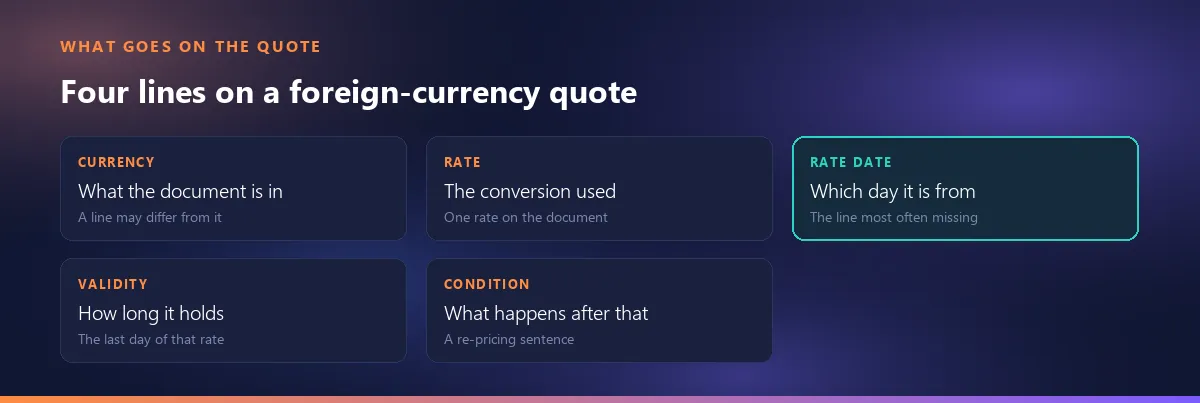
Everything above turns into a small block that sits under the totals or at the foot of the quote. Four lines, plus one sentence where it is needed.
- Currency. Which currency the document is priced in. Write the ISO code rather than the symbol:
USD,EUR,GBP. The “$” sign belongs to at least five countries, and on an export document resolving that ambiguity is your job. - Rate. The conversion used, if the document carries more than one currency. Keep it to a single value that appears once; two different rates in two places on the same page make the document arguable on the spot.
- Date of the rate. This is the line that gets left out most often, and it is the whole point of this article. A rate without a date leaves the ambiguity intact: which day was it taken from? A document that states the date settles the conversation three weeks later in one line.
- Validity. How long the quote holds — which is also the last day of the frozen rate. Writing an actual date is clearer than writing a number of days: “valid 7 days” leaves “from when” open.
- (Optional) The condition sentence. Say in one line what happens after the date: “After this date, prices will be recalculated at the rate then current.” It is not a threat but a convenience — it has the next conversation on your behalf.
The same block goes onto a proforma. The other fields on a proforma — package and piece abbreviations, net and gross weight, the classification code — are explained one by one elsewhere: the other fields on a proforma.
Writing down who carries it: your currency or theirs?
You cannot remove exchange rate risk; you only choose who carries it. The US Department of Commerce puts it plainly to exporters: one of the simplest ways to avoid the risks of fluctuating rates is “to quote prices and require payment in U.S. dollars”. And the consequence is stated in the same breath: “Then both the burden of exchanging currencies and the risk are placed on the buyer.” Both the conversion work and the exposure move to the buyer (trade.gov, Foreign Exchange Risk).
The same page names the cost, and that honesty is what makes it useful: the approach may result in “losing export opportunities to competitors who are willing to accommodate their foreign buyers by selling in the counterparties' local currencies” — you may lose deals to competitors who will sell in the buyer's own currency. The decision lives between those two sentences, and it is commercial rather than financial: whoever has the negotiating power is the one who does not carry the risk.
There is a third route, and it is independent of the quote document: a financial contract that fixes the rate today. The same source describes “a forward contract, which enables the exporter to sell a set amount of foreign currency at a pre-agreed exchange rate with a delivery date from 3 days to 1 year into the future” — three days to a year ahead, at a pre-agreed rate. We mention it purely as context: it is a bank product, it is not a substitute for the document, and it is not the recommendation of this article. If your quote does not carry the date of its rate, no forward contract repairs that ambiguity.
After the quote is accepted: this is where it leaves your hands
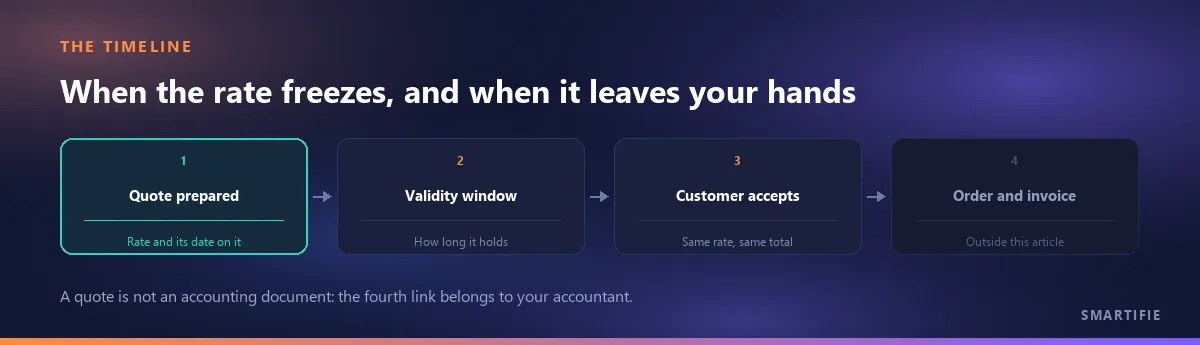
Let us draw a boundary and not cross it. A quote is not an accounting document. It creates no sales entry and no tax obligation; it is a commercial offer, and it binds you to the extent of what you wrote on it. The moment the buyer accepts, the chain moves to the next link: order, dispatch, invoice. How the rate is handled on that link is an accounting question and it differs from country to country. This article does not go there — and if it did, it would not help you, because only your accountant can answer it against the rules that apply to you.
One place where that boundary is unusually visible is Spain, and it makes a useful example. The regulation that governs invoicing obligations (Real Decreto 1619/2012) sets out in detail when an invoice must be issued and what it must contain; yet the text mentions neither presupuesto (quote) nor factura proforma (BOE, RD 1619/2012). A quote, in other words, is not a document the rules define — it is a commercial one, and that is precisely where its strength comes from: you write its terms.
If you want to follow the chain further — how the document that records the goods leaving changes from country to country — that is covered separately: the next document in the chain.
Three mistakes that keep coming back
(a) The rate is written, the date is not. This is the most common and the sneakiest, because nobody looking at the document sees anything missing: the rate is there, the number is there, it all looks complete. The gap only appears three weeks later, when both sides say “but we agreed on such-and-such a rate”. A one-line fix ends a conversation that otherwise has no end.
(b) No validity period on a foreign-currency quote. An undated quote in your own currency is untidy; an undated quote in a foreign currency is an open-ended commitment. The difference: in a domestic quote only your price ages, while in a foreign-currency quote the conversion underneath the price ages too, and the two can turn against you at once.
(c) Mixing line currency with document currency and then correcting the total by hand. One line in euros, the document in dollars; the total looks “off”, so somebody types in the number they believe is right. From that moment the document can no longer verify itself: add up the lines and you do not arrive at the printed total. When a buyer notices, what is on the table is no longer the price but your reliability. The fix is not to correct the total but to find where the conversion was set up wrongly.
What we do on this side, and what we do not
Smartifie Quote is a tool for preparing quotes and proformas, and it applies the principle above as an invariant: the rate is frozen onto the document when the quote is created — the conversion used and the date of that conversion are stored with the document. Whatever the market does afterwards, that quote keeps showing the total of its own day, and the PDF you sent does not drift away from the screen. A line may carry a different currency from the document (a mixed-currency quote), and the choice is not a hand-picked four: the full ISO 4217 list is there. The validity period is a setting printed on the document and ships at 7 days; you change it to suit your business.
The approval threshold is measured through that same frozen rate — a rule like “quotes above this amount need approval” is evaluated with the document's own rate, not today's. If the rate is unknown, the quote goes to approval: letting an unmeasurable quote through is exactly where a large one would slip by unnoticed.
It is worth being equally clear about what the product does not do, because knowing a tool's edges comes before using it. It does not email the quote: the quote is prepared and downloaded as a PDF or an Excel file, and you send that file through your own channel. It does not produce invoices — a deliberate boundary, and the product-side counterpart of the distinction above: quotes and proformas are not accounting documents, and invoicing is a separate world. A quote waiting for approval appears in the list; no notification is sent to the approver.
To close, in one line: a document cannot remove exchange rate risk, but it can remove the argument that comes from having nothing written down. Write the rate, write the date of the rate, put the validity next to it. The rest is negotiation.
A quote tool that freezes the rate and its date onto the document