
There is a packing list or a proforma in front of you and the column headings are letter clusters you do not recognise: CTNS, PCS, N.W., G.W., MEAS, C/NO, P/O NO. Search for them and you find two kinds of page. Alphabetical A-to-Z glossaries on one side, and freight-forwarder posts explaining a single abbreviation in three paragraphs on the other. Both give you the same thing — the meaning. What neither gives you is the part you actually need: which document that abbreviation lives on, who reads that document, and what you do when two documents show different numbers.
The argument of this article fits in one sentence: knowing what an abbreviation means gets you nowhere; knowing which document it belongs to does. The same shipment shows up as three different numbers across three documents — PCS on the invoice, CTNS on the packing list, a package count on the customs entry — and what causes trouble on the dock is not an unfamiliar abbreviation but the same abbreviation carrying different figures on two documents. Below, the abbreviations are grouped not alphabetically but by the job they do, six groups, each tied to a question.
The abbreviation problem is a document problem, not a dictionary problem
If you have the abbreviations memorised and still get things wrong, the reason is simple: the meaning of an abbreviation is fixed, but its context is not. G.W. says the same thing on every document, yet the G.W. on a packing list is the weight of one carton while the G.W. on a transport document is the weight of the whole consignment. Both are correct, both are different numbers, and if you put them side by side and ask "which one is wrong", you have asked the wrong question.
The right question is: who reads this document, and what do they do while reading it? The table below does not define the abbreviations — it shows which document they sit on and what the person facing that document does with them. The rest of this article opens up those rows one by one.
| Document | Abbreviations typically on it | Who reads it / what they do |
|---|---|---|
| Commercial invoice | PCS, INV NO, P/O NO, HS |
The buyer's finance team and customs: they confirm what the goods are and what they are worth. |
| Packing list | CTNS, PCS, N.W., G.W., MEAS |
The carrier and the warehouse: they count the packages and work out how much space they take. |
| Carton label / shipping mark | C/NO, N.W., G.W., MEAS, P/O NO |
The person on the dock: they match the box in hand to a line on the list. |
| Transport document | POL, POD, ETD, ETA, B/L |
The carrier and the destination agent: they fix where the cargo travels from and to, and when. |
| Customs entry | package count, package type, tariff code, net and gross weight | The customs authority: they compare the declaration against the goods and the other documents. |
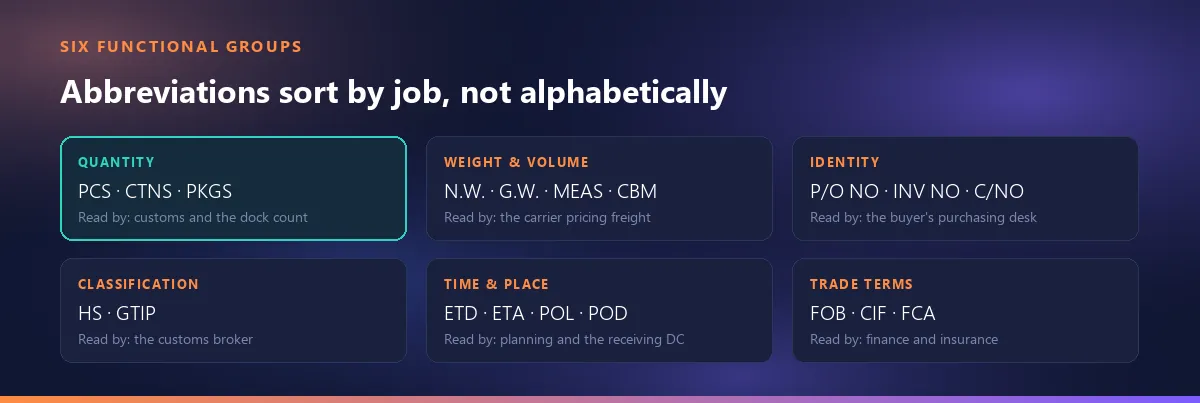
Quantity: PCS, CTNS/CTN, PKGS and the customs package count
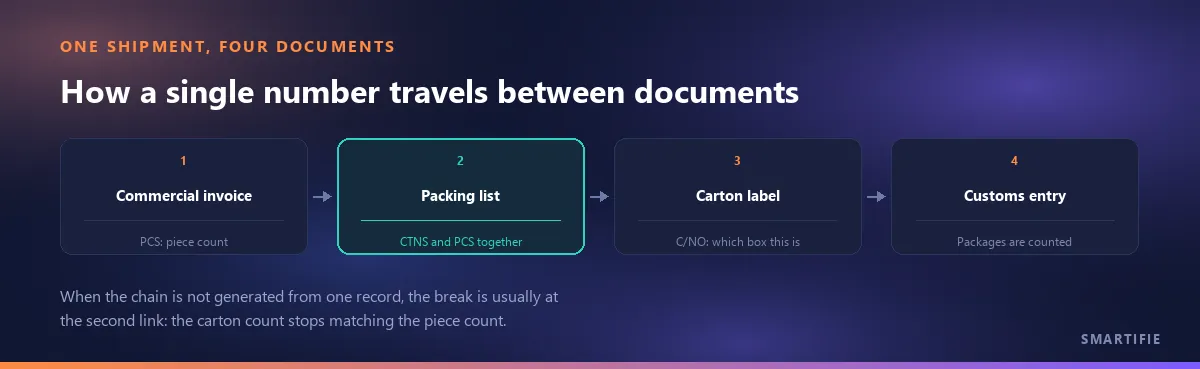
The commonest question: "the invoice says 240, the packing list says 20 — which one is right?" Both are right, because they answer different questions. PCS (pieces) is the count of the goods: how many units you sold. CTNS (cartons) is the count of the boxes carrying them: how many cases you loaded. If twelve units go in a carton, 240 units make 20 cartons and the two documents agree. The moment they stop agreeing is the moment the units-per-carton figure was entered wrongly somewhere.
The third abbreviation, PKGS (packages), is wider, and that is exactly why it gets muddled: it means the number of packages, and a package does not have to be a carton. Pallets, crates, sacks, reels, drums — all of them are packages. If a shipment has 20 cartons but those 20 cartons are wrapped onto 2 pallets and handed over as pallets, the PKGS the carrier counts may well be 2. The answer to "how many packages" depends on what counts as a package, and that is set by how you hand the goods over, not by you.
On the customs side this distinction becomes technical, because what a customs entry counts is packages, not pieces. Whichever country you are declaring in, the declaration asks how many packages are being presented and of what type; the piece count belongs to the invoice, not to that field. The practical consequence for you: telling your broker "20 cartons" is not the whole answer, because the broker also has to say what kind of package those 20 units are, using the codified package types their administration works with.
Which columns these three counts occupy on the list itself, and how the rest of the list is built, is covered separately: which fields a packing list must carry.
CTN does not always mean carton
In search results this abbreviation leads to two completely different answers, and nobody puts them side by side. The first is the one you know: CTN = carton, the box itself, plural CTNS. The second is not a box at all but a document: the Cargo Tracking Note, required on shipments to certain destination countries and also known as ECTN, BESC or BSC.
We are not listing which countries require it, what it costs or how it is obtained: almost every source giving those details sells the service, and the country lists change often. The practical rule is short: if the context is "how many", it is a carton; if the context is "a document", it is the tracking note. If your forwarder writes "send the CTN" and the rest of the sentence is about packaging, they want a carton count; if the rest of the sentence is about paperwork, they want something else entirely. When in doubt one question settles it: a count, or a document?
Weight and volume: N.W., G.W., MEAS and CBM
N.W. is net weight, G.W. is gross weight and MEAS is the carton's measurement; how these three are printed on the box itself, and why they must match the packing list exactly, is covered separately — what these three values look like on the box. What needs opening up here is a different distinction: MEAS and CBM are not the same thing, and which one goes on the document is a recurring question.
MEAS is a measurement: length × width × height, three numbers. CBM is the volume derived from it, a single number in cubic metres. The arithmetic is not in dispute: in centimetres, length × width × height ÷ 1,000,000 gives you cubic metres. A 60 × 40 × 30 cm carton is 72,000 cubic centimetres, which is 0.072 m³. Both can appear on a document — MEAS carries the dimensions, CBM the total — but neither replaces the other: without the dimensions you cannot verify the volume, and without the volume you cannot plan a load.
Why do these two matter so much? Because freight is usually charged on the greater of gross weight and the weight derived from volume — a light but bulky load prices on volume, because it fills the space even though the scale barely notices it. But the factor used in that conversion varies by transport mode and by the carrier's own tariff. We are not copying the fixed factors that circulate online; the only figure binding on you is the one in your contract of carriage or your carrier's tariff. That is also the question to ask when you receive a quotation: which factor did you calculate this on?
VGM is not a weight abbreviation, it is an obligation
"I have written the G.W. — does that cover the VGM as well?" No. G.W. is the gross weight you declare on a commercial document. VGM (verified gross mass) is a separate obligation introduced under the SOLAS convention: the gross mass of a packed container is verified, and that value is a condition of loading the container aboard — without a verified mass, the container is not loaded.
According to the International Maritime Organization's own explanation, the verification is the shipper's responsibility, the value is declared on the shipping document and passed to the master and the terminal operator, and it may be obtained by either of two methods — weighing the packed container, or adding up the items inside and adding the container's tare. The requirement entered into force on 1 July 2016 (IMO). How it is administered where you ship from — which scales are accepted, where the figure is filed — is a matter of national implementation and is confirmed with your carrier. The lesson here is the one that matters: two abbreviations describing the same weight can sit under two different regimes. This is the clearest example of why knowing the meaning is not enough.
Identity fields: P/O NO, INV NO, C/NO, ITEM NO
These four fields describe neither a quantity nor a weight; they tie the documents together. Each one nails two separate pieces of paper to the same shipment, and when one is missing the chain breaks at exactly that link. In order:
P/O NO— the purchase order number. This is the key in the buyer's own system and does not have to match your sales order number; usually it does not. The buyer's purchasing desk receives the goods against this number. Put your own number on the document and omit theirs, and the goods can clear customs and still sit unmatched in the buyer's system.INV NO— the invoice number. It marks the commercial invoice and is what the payment side holds on to. It is also written on the packing list, because that is the only way to tell which invoice the list belongs to.C/NO— the carton number, the sequence number of the box. It marks the physical carton and is the only field that brings a line on the document together with a box in your hand. Why it matters so much, and the form it takes, is covered separately: why the carton number is the most critical field.ITEM NO— the line item number. It pairs a line on the invoice with a line on the packing list. When a shipment carries three different products, this number is the only way to tell which carton holds which item.
One thing to watch: these four fields appear both on the document and on the box, and the two have to be identical. If you need to print them onto the cartons, rather than typing each one you can print these fields in one run with the shipping mark generator — the tool page also explains, field by field, why each one belongs on the label.
Classification: HS and national tariff codes
These two are often used as if they were the same thing, when in fact one sits inside the other. HS — the Harmonized System — is the World Customs Organization's nomenclature, in which each group of goods is identified by a six digit code; the system covers more than five thousand commodity groups (WCO). Those six digits are the same everywhere — they are the common language you share with a supplier on the other side of the world.
The code your customs entry asks for is usually longer than six digits, and how much longer is a national matter — so check the digit count against the administration you are declaring to, not against a general rule. Türkiye is a documented example: the Turkish tariff code GTİP is twelve digits, and the Ministry of Trade sets out the breakdown itself — the first six digits are the WCO's HS code, digits 7-8 are the EU Combined Nomenclature, 9-10 a national subdivision and 11-12 a statistical code (Ministry of Trade). In that structure the national code is an extended HS code: cut it back to six digits and you are left with a valid HS code again.
The part that matters on the dock: the number of digits the other side asks for and the number you write on your document can differ, and that is not a mistake. Six digits are usually enough on a proforma and on a packing list — the buyer wants to know what the goods are. The customs entry needs the full national code. The problem is different first-six digits across the documents of one shipment; a change in digit count is normal, a change in the first six is the alarm. One closing note: an HS code is not a barcode and does not stand in for your product's identity — that is a separate subject, covered in who allocates a product number.
If that proforma is priced in a foreign currency, which day's rate goes on it is a separate decision.
Which fields belong on the proforma itself — HS code, origin, Incoterm, bank details — and how to turn them on in your quoting tool is the subject of a separate article.
Time and place: ETD/ETA, ATD/ATA, POL/POD
The rule for this group hides in a single letter. The leading E means estimated; the leading A means actual. ETD is estimated departure, ETA estimated arrival; ATD and ATA are the departure and arrival that actually happened. The difference is not a spelling detail but a difference in commitment: an ETA is not a promise, it is an estimate, and the carrier revises it as their operation moves.
The practical consequence: hang your production and dispatch plans on the actual dates in your own records, not on an ETA. "The ETA has passed and nothing has arrived — whose fault is it?" is usually nobody's fault; it is the result of treating an estimate as a commitment. The ATA records that accumulate on a given lane, on the other hand, give you a real transit time, and that is worth far more than an estimate.
POL is the port of loading and POD the port of discharge. The mistake made most often here is confusing those two places with the place of delivery: the POD is where the goods come off the ship, not where you hand them to the buyer. Between the two there is an inland leg, a customs procedure and, usually, a cost. That distinction leads straight into the next group — because the abbreviations that decide where cost and risk change hands are a different kind of thing altogether.
Trade and payment terms: FOB, CIF, EXW, FCA, B/L, L/C
These are three letters too, but they are not the same kind of thing as the others, which is why they are kept apart. Everything discussed so far was the name of a field — a label on a number or a date. FOB, CIF, EXW and FCA are not field names but the name of a regime: the three letters you write on the document change who carries the cost and who carries the risk. Get PCS wrong and a number is corrected; get the trade term wrong and the substance of the contract changes.
This article will not teach you Incoterms — the allocation of cost and risk is a rule-by-rule copyrighted text, and the right address is the International Chamber of Commerce's own publication, not a third-hand table. What is drawn here is a boundary: do not treat a trade term as a "field to be filled in", like a column on a packing list. The same boundary applies to B/L (bill of lading) and L/C (letter of credit); neither is a field, each is a document with its own rules, and neither is the subject of this article.
On container shipments, FOB is the commonly misused abbreviation
This is the one concrete, verifiable example of a "misused abbreviation" in this group, so it gets the weight of the section. According to the International Chamber of Commerce's own training publication, FOB is to be used only for maritime and inland waterway transport — that is, port-to-port shipments. For multimodal movements such as containers, the appropriate rule is FCA (ICC Academy).
In practice FOB keeps being written on container shipments out of habit, and usually nothing comes of it — until something does. Who carries the risk between handing the container over at the terminal and the ship loading it is settled precisely by this choice of rule. Read the three letters in your contract once with that in mind; and if they need changing, the place to change them is the contract, not the document.
What happens when the abbreviations disagree
This is where the article pays for itself. Misreading an abbreviation is rarely expensive; what is expensive is the same abbreviation carrying different figures on two documents. The four mismatches below are the commonest break points between documents, and each has a known course of action.
- The
PCStotal does not matchCTNS× units per carton. Usually the last carton was not filled, or the units-per-carton figure changed mid-run. What to do: take the physical count as the truth, correct the packing list to it, and align the invoice to the list. Correcting the invoice and the list independently turns two errors into three. - The
G.W.total differs between the packing list and the transport document. Most often the transport packaging — the pallet, the crate, the wrap — was left out of the list. What to do: settle what the gross weight includes (is the transport packaging in or out?), use that one definition on both documents, and keep the weighbridge ticket. - A
CBMgap created by roundingMEAS. Round each carton by a few millimetres and, across a hundred cartons, the total volume drifts visibly. What to do: round the total, not each carton's volume, and state on the document which unit you measured in. The carrier will take their own measurement; you need to be able to show where your figure came from. - The classification code changes between documents. One code on the proforma, another on the customs entry. A different number of digits is normal; different first six digits are not. What to do: hold the code in one place, on the item record, and write every document from there. Whether the code itself is right is a separate specialism and belongs to your customs broker; your responsibility is that the same code reaches every document.
All four share one behaviour: whoever finds the mismatch must decide which document is authoritative before correcting anything, and must tell the other side in writing. Quietly correcting one document is the commonest and most expensive choice, because the other side still holds the old copy. Everything above is what the sending side does. If you are on the receiving side and the count does not add up, the reservation and acceptance process works differently — we covered that side separately: what the receiving side does when the count is wrong.
What changes when the abbreviations come out of a record
All four mismatches above come from one thing: the same number was typed in more than one place, independently. When the invoice lives in one file, the packing list in another and the label somewhere else again, the only mechanism keeping the figures aligned is human attention — and human attention gives out somewhere around the fiftieth carton. The fix is not memorising the abbreviations better but having all of them derive from one record: the quantity is entered once, the carton count is computed from it, weight and measurement come off the item record, and both the document and the label read the same row.
One distinction here has to be honest. The packing and loading lists Smartifie Logistic produces do not print abbreviations — the column headings are written out: Net Weight, Gross Weight, Volume, Case, Pack No, HS Code, PO No. The side that prints abbreviations is not the app but the free carton label tool on this site: it puts C/NO, N.W., G.W., MEAS and P/O NO on the label, because that is the settled form on a box. The gap between the two is deliberate — a document is made to be read, a label to be seen from a metre away.
What the app actually does: volume is not a hand-typed field but a value computed from the dimensions on the item record — centimetres are converted to cubic metres and the field stays read-only, so two different volumes cannot come into existence in two places. The unit of measure also comes from the record; on the list the quantity cell is written as "240 PCS", figure and unit together. In fairness, here is what the app does not do: there are no port or date fields (POL, POD, ETD, ETA), there is no verified gross mass flow, the classification code is free text with no format checking, and the delivery term is a free text field too. Those belong to the carriage and customs side, not to the shipment record.
You can build this in a spreadsheet too — with formulas, references and care. Why that stops being enough past a certain point is argued separately: why spreadsheet-based shipment tracking runs out. For a one-off job — a few cartons, a trial shipment — the free shipping mark generator on this site is enough: it prints the abbreviations in the settled form and order, and nothing leaves your browser.
To close, back to the opening argument: a glossary of abbreviations will not save you; abbreviations that all derive from one record will.