
You are launching your first product, or tidying up a warehouse, and the same question turns up: where does the barcode number come from? Search for it and you find two kinds of page. Consultants offering to file your application for you, and sites selling numbers outright — no membership, no annual fee, one payment. The question in between, whether you actually need any of this, goes unanswered. This article answers that one: first you work out which branch you are on, then what that branch actually requires.
The argument fits in one sentence: the decision is not “should I get a barcode” but “will this code ever leave my own system”. If it leaves, the number has to be allocated to you, and only GS1 does that. If it never leaves, you join nothing and design your own scheme. A third route is offered — buy the number — but what it sells does not become yours, and the reasons are set out below one by one.
“Barcode” means two different things: the symbol and the number
The confusion starts with the word. In everyday use “barcode” means both the striped symbol you see on a shelf and the number inside it. They are entirely different things. The symbol is a drawing: text turned into thick and thin bars according to a published rule. The number is an identity, and the real question is whose identity it is.
The practical consequence: drawing the symbol is free and unrestricted. Turning a piece of text into a Code 128 or EAN-13 symbol needs nobody's permission and takes seconds with a free tool — the one on this site, free barcode generator does it in your browser. The number side is the opposite: it involves an allocation, a record that makes a number count as yours. This article is about that side from beginning to end.
One question decides it: will this code leave your system?
This is the spine of the article. Set the test up like this: will somebody other than you read this code and look it up in their own system? If yes, the code leaves, which means it has to be unique and it has to be verifiable somewhere as yours. If no, the code stays inside your own walls and how you built it concerns nobody but you.
One thing to watch: the question is not where the product goes but where the code goes. You may be exporting, yet if the number printed on the carton is only read by your own team and the carrier, that code does not leave. Conversely, getting into a single retail chain takes the product number outside. The decision follows where the code is read, not your geography or your turnover.
Three concrete scenarios: retail shelf, customer portal, your own warehouse
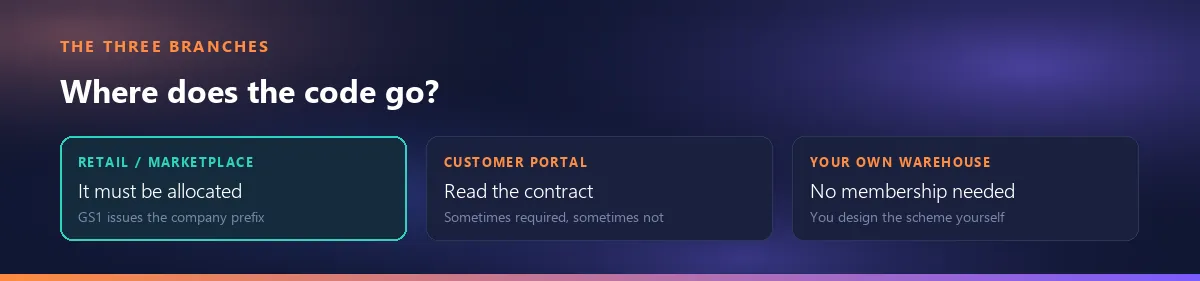
- A product that goes through a till. If it is heading for a retail shelf or a marketplace, the number has to be allocated to you. The scanner at the till looks the number up in the shop's own catalogue; if it is registered to somebody else, another product appears on the screen or the code is not recognised at all. There is no debate on this branch.
- A customer or supplier portal. A chain customer, an automotive supply programme or a logistics portal may ask you for codes. The answer here is not fixed: read the contract and that portal's own guide. Some programmes insist on an allocated number; others are content to map the internal code you send them on their side. Do not guess — ask for the document.
- Your own warehouse only. Bin locations, work order numbers, the package number on a shipping carton, internal stock codes. If these never cross your own walls, you do not have to join anything and you design the scheme yourself. Most small and mid-sized businesses are entirely on this branch without realising it.
If it leaves: who allocates the number and how the process runs
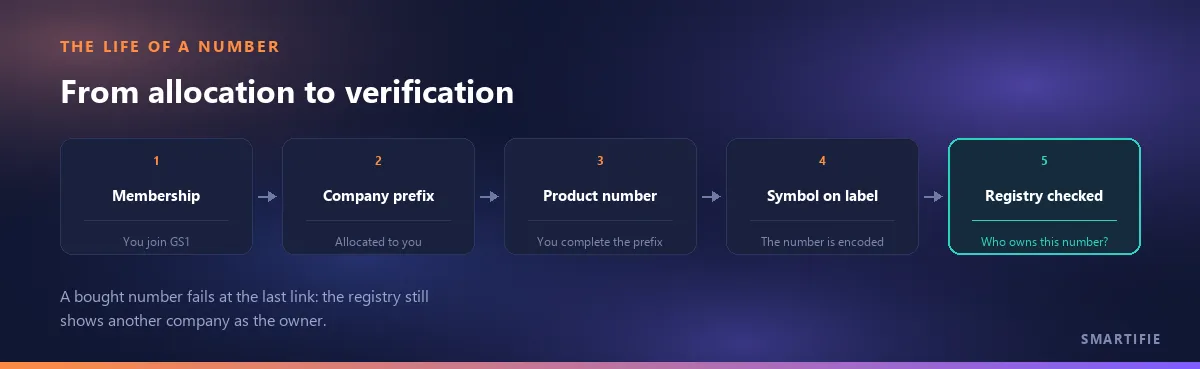
The product number used in retail and on marketplaces (the GTIN) is allocated by one structure: GS1 and its national member organisations. In Türkiye that is GS1 Türkiye, hosted within TOBB; in Spain it is AECOC / GS1 España. You join as a company, you are allocated a company prefix, and you number your own products underneath that prefix.
The commonest misunderstanding here: what you get is not a single number, it is the right to number. Because the prefix is yours, you hand out the range underneath it as you see fit — a new product does not mean a new application. This is why “how much does one barcode cost” describes the structure wrongly: what you sign up for is a membership, not a purchased label.
What the application asks for (the Turkish example)
According to GS1 Türkiye's own application document, the file contains: an application form (not separately required when you apply online), a notarised undertaking, the original chamber of commerce registration certificate and the income or corporate tax return for the last financial year. The list is short, and it is not the list that sinks applications.
Two details do sink it, both stated plainly in the source and both copy-paste mistakes: the company name on the notarised undertaking has to match the name on the chamber registration certificate exactly, and the e-mail address you register with has to be the same one written on the undertaking. When they differ, the application is not accepted. Putting those two fields side by side before you prepare anything saves a week (GS1 Türkiye application document).
Spain is structured a little differently: the application is made online, and GS1 España states on its own page that membership becomes active within 24 working hours of the required documents being received. The same page puts the minimum number of articles you can code at 100 — even the smallest tier is designed for a product range, not for one item.
Cost: why there are no Turkish figures in this article
The honest answer: we do not print figures we cannot verify. GS1 Türkiye publishes its system usage fee as a table rendered as an image, on a page carrying a “2025” heading. Copying a year-old table here would mean handing you a wrong number on the day you read it. There is one right address for the figure: the current tariff page at GS1 Türkiye.
What we can give instead of a figure is the structure, because the structure is stated in words and does not move from year to year: the fee is set so as not to exceed the average of the previous November's consumer and producer price indices, and invoicing happens in September. For budgeting, those are the two useful facts: the increase has a ceiling, and you know which month of the year the cost lands.
Spain is different, because GS1 España states its figures in words on its own page. The structure has two parts: a one-off joining fee and an annual fee banded by turnover. The joining fee is set at 100, 300 and 600 €, with a published reduction of 83.3% for companies whose previous-year turnover is under 100,000 € and 50% for those between 100,000 and 500,000 €. The annual fee runs from 216 € to 1,829 € depending on the turnover band (GS1 España). These figures are specific to Spain and do not apply elsewhere.
Sites selling barcodes “without membership”: whose number is it?
The offer you cannot miss when searching: no membership, no annual fee, one payment, instant delivery. Part of why it looks attractive is true — membership is a commitment, not a single payment. But the question to ask is not the price: whose name is this number registered in? The answer below is not our opinion; it is what GS1 member organisations publish themselves. We name no seller; what we describe is the mechanism.
- The number belongs to the first company. As GS1 UK puts it in its own knowledge hub, a GTIN bought from a third party still belongs to the company it was originally issued to and is not licensed to you or your brand. What you receive is a string of digits, not a transfer of ownership.
- The number may have a history. The same source notes that numbers sold this way may have “previous owners”. Your new product can end up listed under a number that belonged to somebody else's product years ago.
- Once it passes to a reseller, the number is no longer managed by GS1. GS1 Australia's barcode integrity page states it plainly: when a number is resold, there is no guarantee it stays unique within the GS1 system. The same number may well be sitting on somebody else's product.
- The consequence comes back as cost. GS1 Australia also warns that numbers obtained from unauthorised sources can lead to losses from relabelling, repackaging or a customer rejecting the goods. The item that looked cheap turns into the expensive one.
- It fails at the verification step. In GS1 UK's words, if the number is registered to another company your product risks being delisted, and the large marketplaces do not accept such numbers. The only numbers that can be searched and verified in the global registry are those allocated by GS1 member organisations.
Sources: GS1 UK · GS1 Australia. We leave the conclusion to you: these numbers work technically, the symbol prints and a scanner reads it. Where they do not work is the registry — and the registry is exactly what a marketplace or a retailer looks at.
There is also the recurring marketplace question: “does this platform require GS1?” Treat any source that answers it definitively with caution; policies vary by platform and by category, and they change. The only binding text is the seller help page of the platform you are selling on. On some platforms there is an exemption route for listing without a product number, and the conditions for it are set by the platform itself.
If it never leaves: you make your own codes, with nobody's permission
The second branch, as we said at the start, is where most businesses actually sit. Bin locations, work order numbers, asset tags, the package number on a shipping carton, internal stock codes — none of these require an allocation. You apply to nobody, you pay nobody, nobody hands you a number. You design the scheme and you can print your own code as Code 128. The reason for that symbology is simple: it takes a mixture of letters and digits, it is not fixed-length, and virtually every scanner used in a warehouse reads it.
One detail is worth getting right: GS1's own glossary defines a separate category for closed-loop use — the restricted circulation number: identification numbers, defined by the local GS1 member organisation, restricted to a country, a company or an industry. But that is not what a small business does in practice; instead of imitating an EAN-shaped number, it builds its own scheme. Imitating one buys the risk described in section four of this article for nothing in return.
How to design that scheme — how many digits, leading zeros, which letters you refuse to use — is a subject of its own and fills a separate article: how to design the code scheme.
The same product can carry three different codes, and that is normal
Most of the arguments start here: people say “barcode” and mean three different kinds of code as though they were one. All three can sit on the same box, and each answers a different question.
- The product number. It speaks outwards. Every unit of the same product carries the same number, and the number has to be allocated to you. The first branch of this article is entirely about this one.
- The internal stock code. This is your own identity for the item. It says how you name the product in your own system, never goes outside and needs nobody's permission. It does not have to match the product number, and in most businesses it does not.
- The package or carton number. It is specific to that shipment. It does not answer “what is this” but “which physical unit is this”; two cartons of the same product carry different numbers and a number is never reused. In the GS1 world the number at this level is the SSCC, and it is the subject of a separate article.
How the three sit side by side on a label, and which field belongs where, is covered separately: what belongs on a carton label.
If you move to GS1 later: what changes and what breaks
“If I start with internal codes today, do I throw everything away when I grow?” No. Your internal codes stay where they are. A GS1 number does not replace them, it arrives alongside them: your item record holds the internal code and the product number at the same time. There is no need to force both into one field, because they do different jobs.
What breaks is not the code but the packaging. The concrete outcome GS1 UK describes: sellers who started with numbers from the wrong source later had to renumber the whole range and update the packaging, losing sales history and product reviews in the process (GS1 UK). When a listing has to be rebuilt from scratch, the history that accumulated on it is rebuilt from scratch too.
The one-line rule that follows: starting with internal codes is reversible; starting with the wrong number is not. Postponing membership while you do not need it carries no risk; the day you need it you take a prefix and add one more field next to your internal codes. But print a number from the wrong source onto a product going to a shelf today, and the way back runs through the packaging.
Which code we print in the field
There is one place in this article where we have to be straight, because we have no “GTIN module” to sell: Smartifie Logistic does not allocate or generate a GTIN for your product, and does not apply to GS1 on your behalf. The app's item record does not even have a field for a product number. You obtain the product number from GS1 yourself; we are neither an intermediary for that nor an alternative to it.
The barcode we print is squarely on the second branch: a package identity derived from the shipment record. It combines the order number, the order line, the stock code, the configuration, the quantity and the package sequence; the result is an internal code specific to that shipment, printed as Code 128. Our own product is, in other words, a literal example of the “make your own code” branch this article describes.
That code's real job does not end with printing a label: it earns its keep when it is scanned during loading and the record shows which carton actually went on the vehicle. We covered that link separately: barcode-verified loading.
To close, back to the question we opened with. For a one-off job — a few labels, a test, an internal code — the free tool on this site is enough. For repeating shipments the code has to come out of a record, and that is what the app does. Once you know which branch you are on, choosing between the two is easy.