
The vehicle is at the dock, the driver is waiting, and there is a document in your hand that wants a signature. You counted the cartons and the count is wrong, or one pallet is crushed. The next few minutes decide whose problem that difference becomes at the end of the month. This article is not a general procedure for receiving goods. It answers one question: you found a difference, now what. What to check first, what to write before you sign, where that writing has to land to count as a record, and when to refuse the goods outright.
The paperwork is a claim; what is on the pallet is a fact
The document that travels with the goods records what the sender intended at the moment of despatch: this many of that item left the building. Your job is not to confirm that intention but to record what actually arrived. On most days the two agree. On the day they do not, the difference can only be proven while the goods are still on the vehicle and the driver is still standing there. The next morning what you hold is not a difference, it is an assertion. The whole article rests on one sentence: your signature says that what the paperwork claims is what arrived. The moment you sign, the sender's claim becomes a fact both sides accepted, and from then on the burden of the difference is yours.
In what order do you check while the driver waits?
You do not have time to open every box and count it, and that is not a failing, it is how a dock works. So the order of the checks matters more than their depth. Get the order right and only the last step is the one you can safely postpone.
- Carton and pallet count. Compare the total on the document with what actually came off the vehicle. It takes five seconds and it is the most common discrepancy of all: one carton stayed on the truck, one pallet went to another address.
- Is this even your delivery? Do the consignee name, the delivery address and the order reference on the document belong to you? Unloading and signing for another customer's goods costs more than being short.
- External condition. Crushed corners, torn wrap, damp patches, cartons that have been opened and re-taped. This is the only damage you can see without opening anything, which is exactly why it has to be looked at while the driver is there.
- Item and quantity match. Compare the labels on the cartons against the lines on the document. Do this here if the first three checks came out clean and you have the time; if you do not, it can be postponed under a qualified signature.
The rule fits in one line: count and visible damage before the driver leaves, line-by-line verification after. The list the sender prepared is the source document for that comparison; what such a list should carry is set out in what a packing list carries.
What do you write before you sign?
When you find a difference the first instinct is to refuse to sign. In practice that is rarely an option: the goods are already unloaded, the driver has other stops, and an unsigned document protects neither side. The real option is not refusing to sign but signing with a written qualification - you sign, but you write down in your own hand what you are and are not accepting.
What you write has to carry three things at once: what (which item, how many units are missing or damaged), when (date and time) and who (the person handing over and the person receiving, printed name plus signature). Miss one of the three and the note later runs into "who wrote this, and when?". The second rule is the one people skip: the same wording has to go on the copy the driver takes away. A note that exists only on your copy means the two sides are carrying two different documents, which does not close the gap - it doubles it.
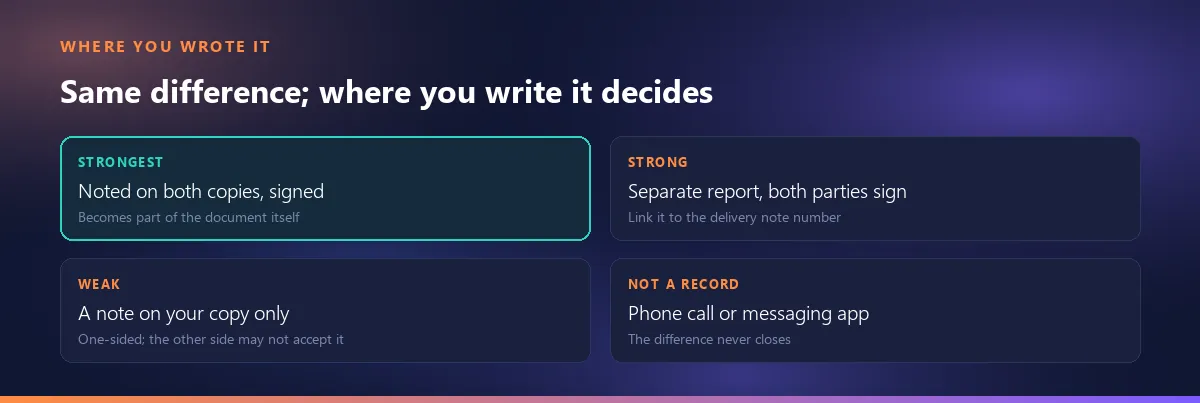
There is a boundary worth naming here: you are the receiver. Reissuing the document, cancelling it or correcting it is the sender's job and follows its own rules; how that side works is covered in how a delivery note is issued. As the receiver, your instrument is not changing the document but adding your own observation to it.
When the packaging is intact and the goods inside are not
Nothing was visible from outside; you opened the box and the product is broken. Here your only defence is time. Photograph it the moment you open it, and get three things into one frame: the box, the label on it and the damage itself. Do not throw the packaging away - keep it with the damaged item. Notify the sender in writing the same day and tie the notice to the document number. A photo taken a day later is, in practice, worth about as much as no photo at all: nothing in it shows that the damage did not happen in your own warehouse. Notice periods and liability depend on your carriage contract and on local rules, so confirm your own position with your accountant or legal adviser.
Three decisions: accept, accept in part, refuse
The decision is made by the goods, not by the paperwork. There are three roads at the dock and one question picks the road: can you actually use what arrived?
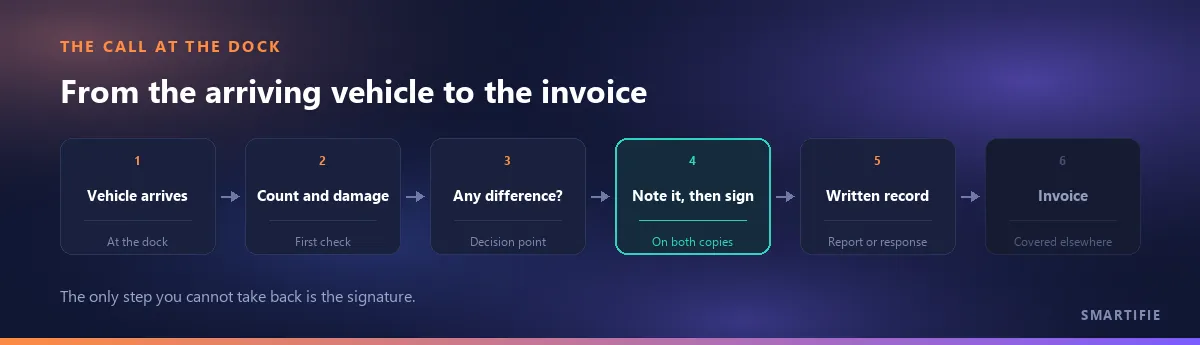
- Accept. Count and condition match the document, there is no difference. You sign, the goods go into stock, the matter is closed.
- Accept in part. Some of it is missing or damaged, but what arrived is usable. Take the goods and write down the difference. The stock goes in, the difference becomes something the sender owes you. This is the road you need most often, and done properly it does not stop production.
- Refuse. The goods are simply wrong or unusable. You do not take them - but not taking them is also a paperwork job. Goods that go back travel with a document of their own, not on an empty truck; that is the next section.
One warning: partial acceptance and partial shipment are not the same thing. A partial shipment is the sender's decision (half the order goes today); partial acceptance is the receiver's decision (part of what arrived is accepted). Where the two get confused, somebody says "it was going to be partial anyway" and the difference is never written down. The operational rule underneath is this: a receiving clerk should not make that call alone. Who gets called in which situation - purchasing, the shipping supervisor, production planning - belongs on a printed list at the dock. When nobody has the authority to refuse, everybody accepts everything.
Electronic delivery notes: is there something to answer?
If the delivery note in your country has moved to an electronic format, there may be a second layer on top of what you wrote at the dock: a formal response the receiver can send back through the system, saying the goods were accepted, partly accepted or refused. Where such a mechanism exists it usually comes with a defined window - a number of days after despatch - and with consequences when nobody answers.
- Responding is usually an option, not an obligation. The process runs even if nobody touches the system - the question is what it defaults to, which is the last point below.
- The window starts at the actual despatch date. Within it the goods can be accepted in full, or accepted in part with the rest rejected - the system-side equivalent of the partial acceptance you decided at the dock.
- A full rejection is usually narrower than people expect. Rejecting the whole document tends to be reserved for specific situations rather than being a general "I did not like what arrived" button. Refusing goods physically at the dock and rejecting a document in the system are two different acts.
- What happens if you never answer? This is the expensive part: where such a window exists, silence is normally read as full acceptance, and the seller invoices the whole quantity. Not answering is not a neutral act - it is a decision.
Rules of this kind are set country by country and change; whether one applies to you, and with what timing, is a question for your accountant.
If no response was sent, how do you prove the difference?
The answer sends you straight back to the dock. When nothing was recorded in the system, what you actually received has to be evidenced by ordinary documents: a signed receipt, a written report, a delivery note copy carrying handwritten notes and both signatures. Which is exactly the qualified signature described above. The two lines you write by hand at the dock are not a workaround for the system - they are the ground the system stands on, and the only thing you still hold when nobody clicked anything.
What document do refused goods travel back on?
You refused the goods. Does the vehicle go back empty? No - and this is the detail most often skipped. Goods that are not accepted still have to travel on a document when they return to the sender or are diverted to another customer, and issuing it is generally the job of whoever transports or arranges the transport, not yours. The practical point: it gets sorted while the vehicle is still at your dock, not afterwards. Sending the driver off with "go on, we will sort it tomorrow" puts goods on the road with no paperwork behind them. The reflex is simple: record the refusal at the dock rather than on the phone, write which items are going back and why, and send that record to the sender the same day.
Which quantity does the invoice follow?
This is where the two lines you wrote at the dock start working for the accounts department as well. An invoice follows what was actually delivered, and the only reason anyone can tell what was actually delivered is that somebody wrote it down at handover. If nothing was recorded, the invoice follows the despatch document by default and the argument moves to a month-end reconciliation call, where two people compare two memories.
The practical conclusion is one sentence: a difference that was not written at the dock gets argued about at month end, and there it is not the better memory that wins but the side with a record. How the delivery note and the invoice connect is a subject of its own; see how a delivery note is issued.
Five mistakes we see most often at goods-in
- Stamping it and moving on. A stamp is not a count. A stamped and signed document says the quantity printed on it arrived; nobody later accepts "I stamped it but I did not count it" as a distinction.
- Saying "we will count it later" so as not to hold the driver up. The count can wait; the note cannot. Write a note that postpones the count: "cartons and external condition checked, contents not verified" takes two seconds and keeps the question open.
- Reporting the difference only by phone or messaging app. The person on the other end may be entirely willing to help, but when they leave the company your report leaves with them. A message is a reminder, not a record.
- Throwing damaged packaging away, or photographing it the next day. The packaging is the only physical basis for a damage claim, and the only value a photo has is when it was taken.
- Leaving it vague who receives and who decides. If nobody holds the authority to refuse, everybody accepts. The clerk's responsibility is not to make the call but to know who to call.
What these five have in common is that none of them is about warehouse layout. All five are about the same two things: whether the difference was noticed before the signature, and where it was written once it was.
The same event from the other side: when you are the sender
Throughout this article you were the receiving side, asking the other party for evidence. Tomorrow, when a customer calls and says the delivery was short, you are the side that has to produce that evidence. The difference is this: as a receiver you only have the moment of handover; as a sender you also have the moment of loading - and loading is a moment that can be recorded as it happens.
Let us be straight about this: Smartifie Logistic does not record incoming goods - there is no goods receiving, no inbound and no returns module. It does not receive an electronic delivery note and it does not produce a response to one. None of the receiving-side work in this article is done in the app. What it does handle is the outbound side: a shipment order is loaded by scanning, the record keeps which user scanned each package and when, a photo taken at the dock is attached to a shipment or loading order number, and the delivery note is produced from that same record. So when a customer says the delivery was short, what you have is a record rather than a spreadsheet to argue over.
Whether that photo taken at the dock is actually worth anything later is a separate question: when a photo taken at the dock counts as proof sets out which shots to take and what the photo has to be attached to.
And once you are on the sending side, the first question waiting for you is who carries the loading and stowage duty - who built the pallet largely decides where a damage discussion ends up.
Further back along the same chain sits the in-warehouse picking step: one reason a delivery goes out short is formed between the racks, not at the dock. picking list — we covered what it is in a separate article.
When the paperwork arrives in another language, the first question is what it is: the same document under another name - we gathered the names country by country, and which of them is a tax document.
It runs on the Windows desktop and in a web browser, and the interface is mobile-friendly. How that outbound check actually works at the dock is described in verifying a load by scanning.