
When a pallet arrives damaged the conversation always opens the same way: "it was fine when it left us". The other side says its own version of the same sentence. Both can be sincere, because in most cases nobody actually looked. This article puts the legal frame plainly first: handling, loading, stowing and packing are, as a rule, the sender's side of the job, and a carrier that can tie the damage to those acts is in a strong position. Then it goes down to the dock: six rules for building a pallet that survives, what stretch wrap really does, how load securing is policed on the road in Europe, and what has to be recorded before the truck moves. The thesis up front: if you built the pallet, you are the party who will be asked to explain it - and the only thing that answers for you months later is the record you kept.
Did the damage happen at the dock or on the road?
A damage discussion nearly always jams in the same place. The sender says it was intact on departure; the carrier says it arrived that way. Neither is necessarily lying. The problem is that neither side can produce anything that was looked at, written down and kept about how that pallet appeared at the moment it went into the vehicle. Loading ends, the doors close, and the moment belongs to nobody.
So the question itself has to change. The one that works at the dock is not "who is right" but "who can show something". That is where the thesis of this article sits: if you built the pallet, the easiest explanation available to the other side is that the damage started there - and the only thing that makes that explanation harder is the record you kept while loading. For the other end of the same event, that is what the receiving side does when it finds damage, we wrote a separate article.
Whose job is loading, stowing and securing?
Start with what happens rather than with a rule. At most docks the sender's own people build the pallet, stack it and put it into the trailer; the driver watches, sometimes from the cab. Nothing about that arrangement is unusual - and it quietly decides who has to explain the load afterwards. Unless the contract of carriage allocates it differently, the party that performed the loading and the stow is the party whose work is in question when the pallet comes apart. "The haulier knows what he is doing" is not an allocation of responsibility; it is a hope.
The split that matters is not between "careful" and "careless" but between two different jobs, and it fits in one line:
Keeping the load sound within itself is the sender's side; keeping the vehicle safe with that load on board is the carrier's.
On paper the distinction looks obvious; applied, it settles half the argument. Cartons crushing each other inside the pallet, a box collapsing, a layer sliding: that is built into the pallet, and the pallet was built by the sender. A load sitting unbalanced in the vehicle, spilling when the doors open, a vehicle that cannot travel safely: that crosses into what the carrier owes. The only moment at which both sides are visible is the moment before the doors close.
What if the contract says otherwise?
The rule is a default, not a wall: the parties can agree that loading, stowing or unloading belongs to the carrier. The practical consequence is one line long - that agreement only helps if it is in writing. "You load it" said at the dock holds on to nothing later. Where such an agreement exists, the contract copy is the first document in the damage file, and the first paper you will go looking for. Check your own contracts with your legal adviser.
Packing is a separate duty
"The stow was fine, the carton collapsed" does not move the problem anywhere, because packing is its own duty and it sits with the party who chose the box. In practice this is where a claim quietly dies: the carrier does not have to argue that it drove well, only that the packaging was not fit for what the journey does to it. Nobody at the receiving end can tell a stowage failure from a packing failure by looking at the pieces, which is why the question comes back to what was decided before the pallet was wrapped.
"Unfit" here does not only mean bad packaging. It covers packaging that was fine for one purpose and wrong for this one, and packaging that was never there. The common version is not carelessness but habit: the box was chosen for a carton that travels on its own, and then the same box goes out stacked on a pallet. A box that stands perfectly on a shelf gives way once more than its own weight rests on it - and when it gives way, the discussion returns to who chose the box.
Six rules for building a pallet that survives
Everything above was about where responsibility sits. What follows is about being able to carry it. There are six rules, and all six are qualitative: they are applied by judgement, not by measurement. Almost every wrap-count, micron and percentage table circulating online comes from a site that sells packaging material and has no traceable source behind it - which is why none of them appear here.
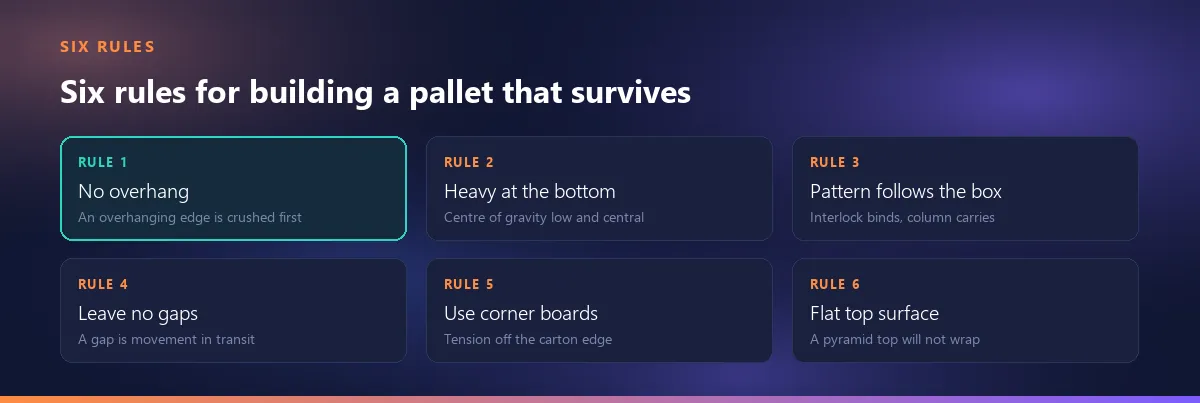
- No overhang. Cartons stay inside the edge of the pallet. An overhanging edge is the first thing to be crushed, and it cannot carry what is stacked on top of it either, because there is nothing underneath it to push against.
- Heavy at the bottom, light on top. The point is to keep the centre of gravity low and near the middle of the pallet. A pallet with its weight up high spends every brake, every corner and every forklift lift trying to tip itself over.
- The pattern follows the box. An interlocked pattern ties the layers to each other and holds the pallet together; a column pattern stacks corner over corner and preserves vertical strength. Which one is right depends on the box: if the corners carry the load, stack in columns; if they do not, interlock.
- Leave no gaps. A gap inside a layer is movement in transit. A carton that can move eats its own corner first and its neighbour's second. If the gap cannot be closed by arrangement, fill it; do not leave it on the assumption that the wrap will pull everything together.
- Use corner boards. A corner board takes the tension of the wrap onto itself instead of onto the thin edge of a carton. A pallet where the tension sits directly on the box edge is being crushed by its own wrapping before it even reaches the truck.
- A flat top surface. A pallet that ends in a pyramid can neither be stacked on nor wrapped properly; the film finds nothing to hold on to at the top corner. Close the top with a level layer, or move the leftover cartons onto another pallet.
What stretch wrap does and does not do
The most expensive misunderstanding on any dock fits in one line: stretch wrap binds the cartons to each other and to the pallet; it does not attach the load to the vehicle. Those are two separate jobs, and the second one belongs to straps, lashings, blocking, dunnage and the rest of the securing kit inside the trailer. "We wrapped it well" says nothing at all if the load then stands free in the vehicle.
Two warnings go with it. First, over-tightening on a wrapping machine is a cause of damage rather than a form of safety: the film pulls the cartons into themselves and can take their strength down before the truck has moved. Second, the wrap has to catch the pallet itself; a wrap that only circles the stack of cartons lets the load slide off the top while the pallet stays where it is. Stretch film is a good material doing its own job - the trouble starts when it is asked to do somebody else's.
Load securing on the road: what the framework says
The commercial frame is only half of it. In cross-border road transport the convention itself does the heavy lifting: a carrier is relieved where the damage arises from handling, loading, stowing or unloading performed by the sender or the consignee (CMR, art. 17/4). That is the provision a claim runs into when the pallet was built at your dock, and it is the reason the answer has to exist before the vehicle leaves rather than after the claim arrives.
Two more things belong in the same frame. In the EU, roadside technical inspections cover load securing as well as the condition of the vehicle (Directive 2014/47/EU). And where lashing forces have to be calculated rather than estimated, the European standard used for that work is EN 12195-1. The practical consequence is the same on both sides: a bad stow does not only produce damage, it produces a roadside record of how the vehicle was loaded - written by a third party, months before anyone opens a claim file.
"Shipper's load and count" on the bill
There is a note that turns up on bills of lading and consignment notes and that most senders read past: shipper's load and count, or wording to the same effect. It is not decoration. It records that the carrier did not verify the count or the condition of what went on board - the goods were loaded and counted by the shipper, and the driver signed for what he was told was there. Where that note is on the paperwork, the description of the load is your description, and the pallet inside the wrap is your pallet. Anything you want to be able to say later about how many cartons left and what state they were in has to come from your own record, because the transport document is deliberately not saying it.
What do you record before the truck moves?
Here is the part that actually pays for itself. The practical summary of the legal side is this: where the circumstances make it plausible that the damage came from the sender's own handling, loading or stowing, that is the explanation the claim will settle on. If you built and loaded the pallet, the only thing standing against that explanation is the record you kept. Without a record you have a story to tell and nothing to show.
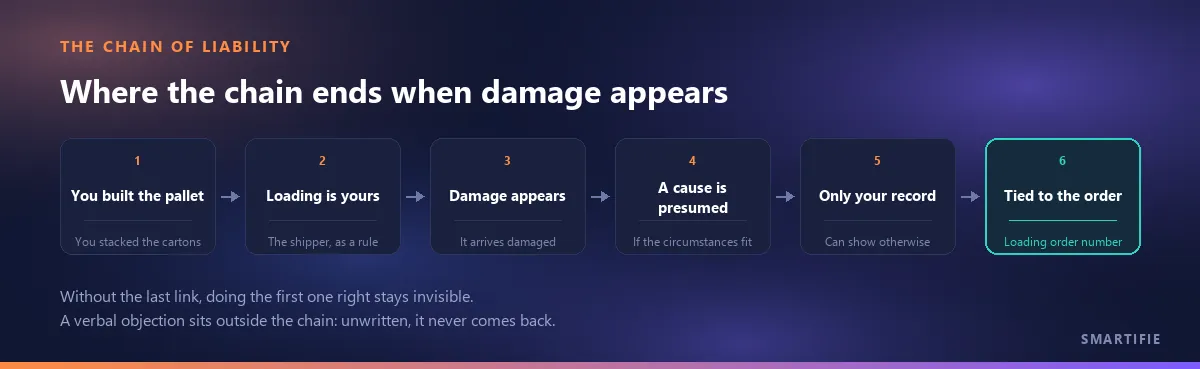
The list is short, and none of it lengthens the loading:
- Who built it, who stacked it, who approved it. A name and a time. Months later this is the only thing that answers "who was on the dock that day", and memory does not answer it.
- How many pallets, and how many cartons on each. A count that matches the shipment order line. The moment a damage discussion turns into a shortage discussion, the count is the only thing left standing.
- The finished pallet, and the pallet in the vehicle. The photograph itself is a subject of its own: which frames to take and what the photo has to be attached to are set out in when a loading photo counts as proof.
- The loading order number. This is the single key everything else hangs on. Not a filename in a folder but a line in a record: filenames get moved, renamed and deleted, lines stay.
- The driver's objection, if there is one. "That will not hold" grips nothing while it stays verbal. A reservation written onto the copy of the delivery note or transport document cannot be removed later - by either side.
Verifying pallet and carton counts while the vehicle is being loaded is a subject of its own: verifying a load by scanning covers it. The closing line of this section: none of this prevents damage from happening; all of it moves the argument in your favour once damage has happened.
Five mistakes we see most often
- The wrap went round the cartons but never caught the pallet. The load slid off the top and the pallet stayed put. The film did its job in the wrong place.
- The pallet was built correctly and nobody wrote down who built it. Work done well but never recorded stays invisible; months later there is no trace that it was done well at all.
- Photos were taken and left in a phone gallery. A frame that is not attached to a shipment is not in an archive at all; when the device changes, it goes with it.
- The driver said "that will not hold" and it stayed verbal. The warning was right and no document carries it. Later nobody can show the sentence was ever said, and the argument starts from zero.
- The packaging was chosen for a single carton and then travelled stacked on a pallet. The box was strong on its own and was never meant to be at the bottom of a stack. That is exactly where the damage showed up.
What changes when the stow and the record live in the same place?
One boundary first, because there is no solution being sold in this article: Smartifie Logistic does not decide how you build a pallet. It produces no stacking plan, no layer pattern, no box layout and no lashing calculation, and the app has no damage-report or claim-file module. The six rules above are a decision made by the person at the dock, not by software.
What it does is the next step: it ties the decision made on the floor to the loading order. Shipment orders and loading orders live in the app; a load is verified by scanning, and the record keeps which user scanned each package and when. A photo taken at the dock is attached not to a gallery but to a shipment order or loading order number. The packing list, the carton label and the delivery note record are produced from the same data, and the reports read from the same record. Months later that shipment comes back to you in one piece: how many pallets left, who loaded them, which photo exists.
It runs on the Windows desktop and in a web browser, and the interface is mobile-friendly. Which brings the article back to where it started: building the pallet properly does not protect you from damage, but being able to show that you built it properly protects you from the argument.