
A delivery note is the document that travels with the goods and shows that a shipment left the seller and is on its way to the buyer. It is often confused with the packing list, but the two answer different questions: the packing list says what is inside, the delivery note records that the goods actually moved. This guide looks at the document from the loading dock rather than from the accounts office: when it is issued, which fields it needs, how many copies travel and what to do when something changes at the dock.
Note: obligations around delivery notes and invoices are set by local regulation; check your own situation with your accountant.
When is a delivery note issued?
The general rule fits in one sentence: the note is written before the goods leave and travels in the vehicle carrying them. A note completed back at the office after the truck has gone has already missed its purpose.
Tying the document only to sales is another common mistake. If goods physically move, they need paperwork: transfers between your own branches or warehouses, samples sent to a customer, consignment shipments and returns coming back from the buyer are the usual cases. There is no invoice in any of them, yet the goods are on the road and something has to travel with them.
What a delivery note must include
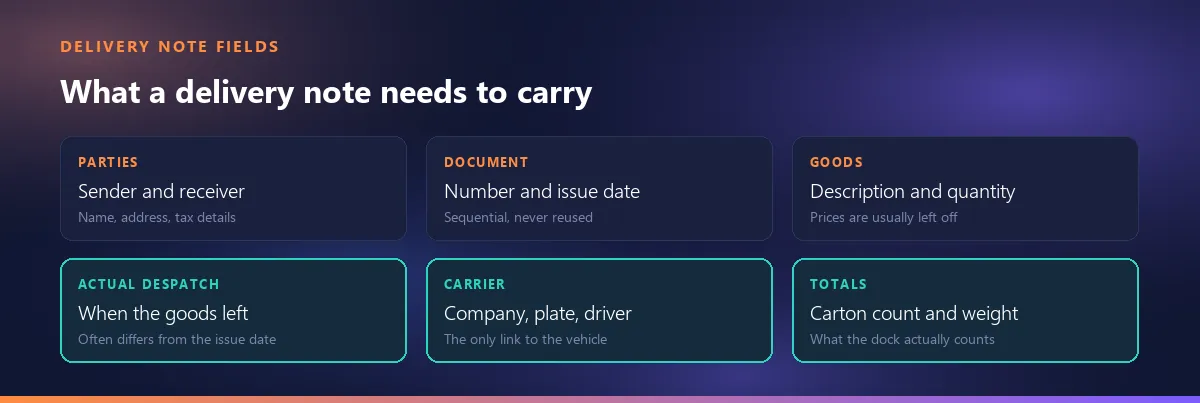
There is no single international standard, but the core set below appears on practically every delivery note. Local regulation may add to it, so confirm the minimum content that applies to you.
- The name, trading name, address and tax details of the sender and the receiver.
- The document number and the date it was issued. Numbers run in sequence and are never reused.
- The description and quantity of the goods.
- The date the goods actually left.
- Where and to whom the goods are going: the delivery address.
Three more lines earn their place in practice: the carrier, vehicle plate and driver; the total number of cartons; and the total weight. These are what make the document usable at the dock. A note without a plate number cannot say which vehicle is being talked about when a delivery is disputed. When the document is issued electronically, the rules around those three lines change too — how the carrier line works on an electronic note.
Inside the line "description and quantity of the goods" hides a second decision most people never notice: which unit goes next to the quantity, and where that unit comes from. On an electronic document it is not free text but a value from a code list — and a carton is not on that list: the unit code next to the quantity.
Do prices go on it?
Usually not. The delivery note answers "what moved", not "what it costs"; the amount belongs on the invoice. Most companies deliberately leave prices off, because the people who read the note - warehouse staff, the driver, the receiving bay at the other end - have no reason to see commercial terms.
How many copies, and who keeps which?
There is no worldwide rule, but the three-copy pattern is the commercial norm and some countries make it mandatory, so check what applies to you. The logic is simple: one copy has to stay with the goods, one has to come back signed, one has to stay in the file.
In practice: one copy stays with the buyer, one comes back signed by the buyer and is archived by the sender, and one stays in the sender's file. The signed copy that comes back is your proof of delivery. Filing it without linking it to the shipment record is what turns a five-minute lookup into a two-hour search months later. Make sure the receiver's name and the date of receipt are legible on it.
The field most often filled in wrongly: the actual despatch date
The date the note was printed and the date the goods actually left are two different things, and a good delivery note carries both. Even when they fall on the same day, write both. A blank date field is what makes a document arguable later.
This distinction maps onto a very concrete warehouse problem. Notes are usually printed in a batch in the morning, while the vehicles leave in the afternoon or evening. The issue date is the morning; the actual despatch date is the moment the vehicle really pulls out. Filling the despatch date in at the moment of loading, on a note printed earlier, is normal practice.
Two traps hide here. The first is a vehicle that does not leave that day: if the departure slips to tomorrow, the despatch date has to move with it. The second is not recording the time of departure at all. Even where the hour is not required on the document, companies that capture it close "when did it leave, when was it delivered" arguments in minutes. Keep the time in your record even if it never gets printed.
From loading order to delivery note: the right sequence
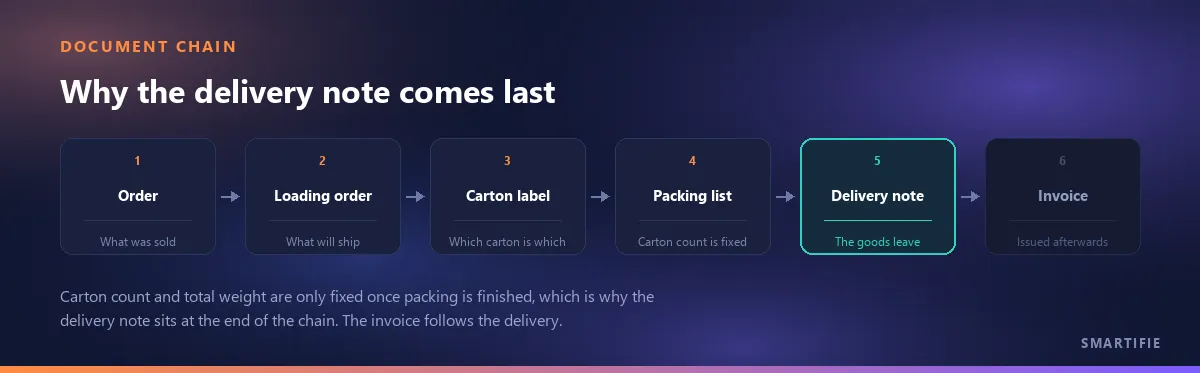
A shipment is not one document but a chain of them, and the order is not arbitrary. Running the chain backwards - issuing the delivery note before packing is finished - is where most dock errors come from.
- The order is confirmed: what was sold and which lines will ship.
- A loading order is opened: which orders go into this shipment and when the vehicle leaves.
- The cartons are packed and numbered, and each one gets a barcoded label - printing barcoded carton labels is covered in a separate post.
- The packing list is prepared: which item is in which carton, total carton count and weight. How to Prepare a Packing List
- The delivery note is issued: parties, goods, carrier and plate, total cartons and the actual despatch date go on the document, and the vehicle leaves.
The sequence shows why the delivery note comes last: the total carton count and total weight are only fixed once packing is finished. Issue the note first and you are guessing at those two lines - and when the guess is wrong, the paperwork and the load no longer match.
What if the quantity changes at the dock?
The note is issued, then a carton does not fit in the vehicle, or one more is added at the last second. This is not rare, it is routine. The answer depends on where the vehicle is.
If the vehicle has not left, fix the paperwork before it does. The cleanest route is to reissue the note and keep the cancelled one on file. If you correct the document instead, the correction has to appear identically on the original and every copy, with the old value still readable, signed or stamped - and local rules on this vary, so confirm yours. The operational point stands either way: the total carton count and total weight on the note must match exactly what went into the vehicle.
If the vehicle has gone, do not try to correct the note retroactively. A short or over delivery is recorded with the other party at the moment of handover: the receiver writes the difference on the copy they sign, so both sides see the same number. The gap is then closed with a return or a follow-up shipment. We looked at why this trail disappears in a hand-kept spreadsheet in Why Spreadsheets Stop Working for Shipment Tracking.
How does the other side write that difference down, and what do they check before signing? how the same event looks from the receiving side.
How the delivery note and the invoice connect
The delivery note records that the goods moved; the invoice claims the money for that movement. The two are tied together by writing the delivery note number and date on the invoice, which is the field that does the most work when the two sides reconcile their accounts. How soon the invoice must follow the delivery is set by local rules, so confirm the deadline that applies to you.
Some regimes also allow a combined document that serves as both delivery note and invoice, so the goods and the billing travel together. It removes one document when you ship to a regular customer at a fixed price, and is useless when the price is not known at the moment of despatch. We compared what each of the three documents - packing list, delivery note, invoice - actually answers in How to Prepare a Packing List.
Paper or electronic? Which one applies to you
Several countries are moving dispatch documents from paper to a mandatory electronic format, usually phased in by annual turnover and by sector. Two things decide whether it affects you: whether electronic invoicing already applies to your business, and whether your turnover has crossed the current threshold. Thresholds and start dates change, so confirm yours with your accountant rather than with a blog. If you are outside the scope, a paper delivery note remains perfectly valid - and either way the data on it should come from the same record.
We will cover the integration side - formats, service providers, ERP connections - in a separate post.
If the threshold catches you, what next?
- Ask your accountant whether you are in scope, and from which date.
- Check your electronic invoicing registration; that is the prerequisite.
- Prepare your document flow: settle now where the delivery note data comes from and who fills it in.
If you ship abroad, both the name and the legal weight of this document change: what the delivery note is called abroad goes through it country by country.
What changes when the note is generated from the record?
In Smartifie Logistic the delivery note is not typed up as a separate document; it is generated from the loading order. Carton count, total net and gross weight, carrier, plate and driver all come from the same record. The issue date and the actual despatch date and time are separate fields, so a vehicle that slips to the next day does not mean rewriting the document. From the same record you can print a PDF, export to Excel and export a UBL-format despatch advice XML.
It runs on the Windows desktop and in a web browser; the interface is mobile-friendly, so you can use it from a phone at the dock.