
A customer in Spain writes "envíanos el albarán". The buyer in Mexico asks for a "nota de remisión". The one in Peru wants a "guía de remisión". All three look like the delivery note you already issue. All three are not the same thing. This article first sets out what the document is called country by country, then explains the difference that actually matters: in Spain it is a commercial paper - the rules on invoicing obligations do not even mention it. In Mexico, Peru and Chile it has been replaced by an electronic document that the tax authority has to clear before the truck can move. Argentina took a third road: the document exists, but it no longer has to be printed. At the end we come back to the three records that stay the same whatever the paper is called.
Is it the same document under another name?
Short answer: the function is the same, the legal weight is not. Under six different names in six countries, this paper fills the same gap everywhere - the gap between the moment the goods leave the warehouse and the moment the invoice is issued. But in one country a commercial custom fills that gap, while in another it is filled by an electronic document that the tax authority numbers and clears. That is why the answer to "what is it called" is never just one word.
The chain starts earlier than that - at the quote, and the rate fixed on it.
The three jobs the document does everywhere
- It records that the goods left. Something went out of the warehouse and the moment it went out was written down somewhere. That is the stock movement's counterpart on paper.
- It gets the quantity confirmed on delivery. The other side counts what arrived and puts that count on the document. This is the document's only genuinely dramatic moment.
- It shows what actually went out when there is a dispute. Months later, when someone says the delivery was short, this is the document the argument turns on - or rather, what was written on it.
What separates it from the invoice: it carries no amounts
This distinction holds in all six countries and it is useful at the dock: the document says how much went out, not for how much. The person receiving the goods does not need to see unit prices, discounts or payment terms - and usually should not. How the goods were gathered off the shelves in the first place is a step further back, covered in a separate article: picking list.
Country by country: what is it called?
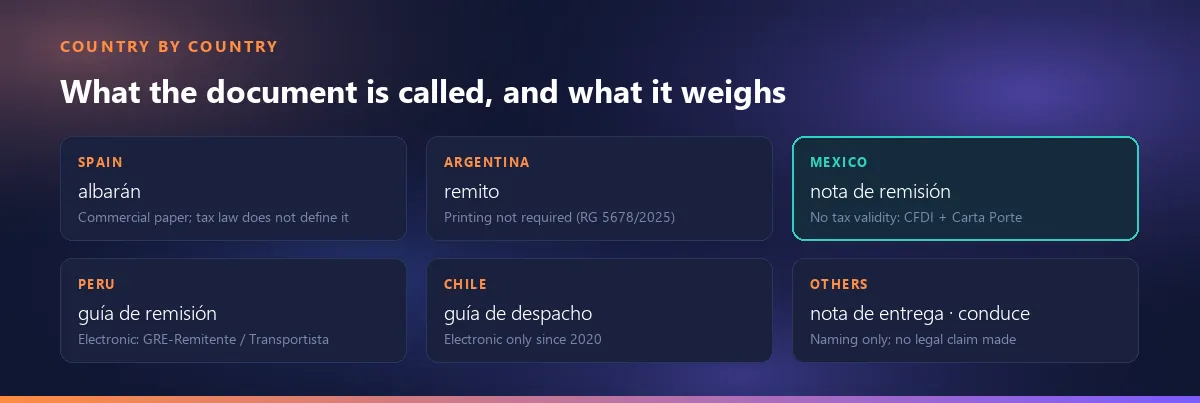
The table below gives names only. Claims about legal weight are made in this article for five countries alone - Spain, Mexico, Peru, Chile and Argentina - because those are the five where we can point to an official source. The rest appear in the table by name, and that is where they are left.
| Country | Name of the document |
|---|---|
| Spain | albarán |
| Argentina, Uruguay, Paraguay | remito |
| Mexico | nota de remisión |
| Colombia | remisión / nota de remisión |
| Peru | guía de remisión |
| Chile | guía de despacho |
| Venezuela | nota de entrega |
| Dominican Republic | conduce |
Spain: the albarán is not a tax document
Anyone researching this document in Spain runs into the same fact: the word albarán does not appear at all in the text of RD 1619/2012, the regulation that governs invoicing obligations. It regulates the invoice, substitute documents, corrective invoices, their content and their retention; it does not regulate the delivery document. The albarán is not a tax document - it exists by commercial custom.
That cuts both ways. On one side the format is free: there is no mandatory field list and you set up your own numbering. On the other, no official text is protecting you - whether the document is worth anything depends entirely on what you put on it and what the other side signed.
So do I have to keep it?
Tax law may not define the albarán, but commercial law covers business documents in general. Under article 30 of the Spanish Código de Comercio, traders must keep their books, correspondence, documentation and supporting records in good order for six years, counted from the last entry in the books. The clock therefore does not start on the date of the document but at the close of the accounting records.
There is one more sentence that advisory articles repeat: if the invoice refers to the delivery document, that document becomes part of the invoice's supporting evidence and is kept with it. This is settled practical advice rather than a rule sitting in a statute under an article number - and we present it as such. Check your own position with your accountant.
Mexico: the paper you are asking for has no legal weight
When your Mexican customer asks for a "nota de remisión", they are most likely talking about an internal control document. It is widely used between companies, but it has no tax validity before the tax administration (SAT). The document that covers the movement of goods inside Mexico is a different one.
That document is the CFDI, issued together with the Complemento Carta Porte when it has to cover transport. SAT's own page draws the scope wide: all individuals and legal entities moving goods on national territory issue it - even when they use their own vehicles. Where a transport service is being provided, an Ingreso type CFDI is used; where the owner or its representative moves its own goods, a Traslado type CFDI with zero amounts is used. And since 17 July 2024 only CFDI version 4.0 with Carta Porte 3.1 is valid.
This article gives no penalty amounts and no count of mandatory fields: the figures circulating online could not be traced to a primary source. Confirm whether you are in scope, and which CFDI type applies, from SAT's own page or with your accountant in Mexico.
Peru and Chile: cleared before the truck moves
These two countries change where the document sits in the dock sequence. There is no step where you fill in a pad by hand and hand it to the driver; the document comes out of a system, and the truck does not move until that step is done. The chain below shows where the electronic document enters the sequence.
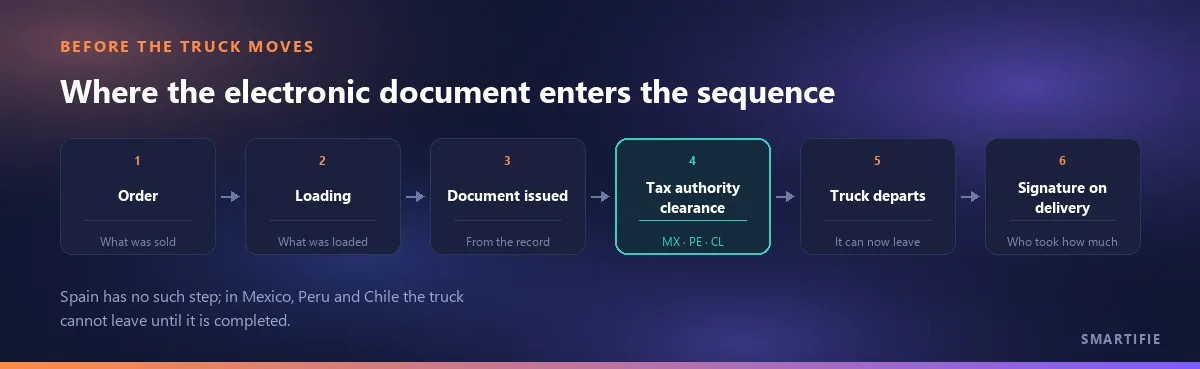
Chile. SII states it plainly: since 17 January 2020 all guías de despacho may only be issued electronically. The consequence at the dock fits in one line: there is no pad of paper forms any more, the document comes out of a system.
Chile has a moving file open
By Res. Ex. N° 154 of 5 November 2025, SII imposed additional requirements on the invoices and dispatch documents that cover the movement of goods ("Fíjase exigencias sobre las facturas y guías de despacho que amparan el traslado de bienes corporales muebles"). The entry into force was changed once during 2026, by Res. Ex. N° 52 of 10 April 2026. We are not printing the new date here, because it could not be verified in readable form in the primary text. Confirm the current date in SII's official lists of resolutions: 2025 resolutions and 2026 resolutions.
Peru: the two documents everybody mixes up
In Peru the guía de remisión is electronic (GRE) and there are two separate documents. The GRE-Remitente is issued by the consignor; it can be issued free of charge from SUNAT's portal and its series is a four-character alphanumeric value beginning with "EG". The GRE-Transportista is issued by the carrier - and it can only be issued once a GRE-Remitente has been received. The consequence at the dock: the carrier cannot produce its document until the consignor has produced theirs. Break the order and the truck waits.
There is a fresh change for anyone shipping across borders: RS N° 000108-2026/SUNAT (published 31 May 2026, in force 1 June 2026) changed who issues the GRE-remitente in foreign trade: the customs agent may now issue it only where the owner or consignee of the goods has granted them a power of attorney. Without that mandate, the party obliged to issue the document is the importer or exporter themselves. So "the customs broker will deal with it" is no longer an automatic assumption when shipping to Peru.
We have left out the dates circulating online for when the paper guía finally disappears; they could not be verified in SUNAT's own text. Confirm the current position on SUNAT's electronic document pages.
Argentina: you no longer have to print it
Argentina made the most operational change on this list. Under RG 5678/2025 (Boletín Oficial, 22 April 2025), where the remito is produced by computerised systems it does not have to be printed; a digital graphic representation of the document may be presented instead. The step where somebody waits at a printer on the dock simply disappears.
That does not mean the document has gone away. Three rules in the same regulation rebuild the paperwork flow:
- A copy goes to the recipient. Where the document is not printed, an electronic copy is sent to the recipient and one copy stays with the issuer.
- The CAI obligation stands. The digital representation does not remove the duty to obtain the printing authorisation code (CAI); the code has to appear on the document.
- Two years of availability. The copy must be kept available to ARCA for at least two years from the date of issue.
Read together, the picture is this: the paper went, the obligation did not. A business that stops printing no longer has to answer "where is the copy" but "who is holding that record for the next two years".
Three records that do not change, whatever it is called
So far this was about the name and the legal weight. Now for the question the article is actually about: what do you do? Across six documents in six countries, three records stay constant, and none of them comes from a statute - they come from the moment of handover itself. Paper, XML or an image on a phone screen, these three do not change.
1. Who took delivery
A name and a capacity. A company stamp on its own does not identify a person - it identifies a company, whereas the question asked months later is "who was at the door that day". An illegible signature ends up in the same place. With a name, a capacity and a time, that moment is attached to a person; without them it is attached to an organisation, and organisations do not remember.
2. How much they took
Not the quantity printed on the document but the quantity <strong>actually received, line by line</strong>. Most of the time these are the same; the cases that turn into arguments are precisely the ones where they are not. Stamping "received" on a document that says sixteen cartons does not change the fact that fifteen came off the truck - it only makes that fact invisible.
3. Whether a reservation was written
When a discrepancy is spotted, the note written onto the document before signing is the one thing that cannot be added afterwards. We covered this in a separate article and pass over it in one line here: what to write before you sign.
When the document is electronic the three records move, they do not vanish
An electronic document does not solve these three by itself. The XML that goes to the tax authority shows that the goods left; it does not show what the recipient saw at the dock. If fifteen cartons came off the truck, a document filed with sixteen does not correct that. The record of the handover still has to sit with you - and its most concrete form is usually a photograph: when a loading photo counts as proof.
Shipping from home: two documents, two countries
This is the question that comes up most: "will my own electronic delivery note work over there?" The answer is short. An electronic delivery note issued under your own country's rules is your country's document and it covers the movement at home; it does not cover the movement inside Mexico, Peru or Chile. The document covering the domestic leg in the destination country is issued by the party there - the buyer, the carrier or the customs agent - under their own rules. One shipment can therefore involve two documents and two different obliged parties.
This article does not give customs or export advice; who issues which document depends on your agreement with the buyer and on the destination country's rules. How the document is drawn up on your own side is set out step by step in a separate article: how to issue a delivery note.
What changes when the document comes from the record?
Let us put the boundary up front, because this article has no solution to sell: Smartifie Logistic does not produce a Carta Porte, a CFDI, a GRE, a guía de despacho or a remito. It does not file documents with any tax authority, it does not pick a document type by country, and there is no such feature as foreign e-document support. None of the regulatory work described above is done in the app; that belongs to the local system in the destination country.
What it does is the step before that: producing the document from the record. The delivery note is not typed up as a separate document; it is derived from the loading order and frozen once issued - if the source loading order changes later, the document does not. Partial shipments and consolidation are tracked line by line: one loading can produce several documents, and several loadings can produce one. From the same record you get an A4 form as PDF, the packing list and the carton labels come from the same data, and the carrier, plate and driver stay attached to the document.
The interface runs in Spanish and calls the document by its own name, <em>albarán</em>. It runs on the Windows desktop and in a web browser, and the interface is mobile-friendly. Which brings the article back to where it started: the name of the document changes by country and so does its legal weight - but the record of who took how much stays on your side in every one of them.