
A packing list is the document that shows what is being shipped, in which carton, in what quantity and at what weight. Prepared properly it turns counting the goods at the other end into a matter of minutes; prepared badly it keeps the vehicle waiting at the dock.
What is a packing list for?
It makes life easier for three parties. The warehouse sees which carton belongs to which order. The carrier plans the vehicle correctly using the total carton count and weight. The buyer counts against the list on arrival and, if something is missing, can say immediately which carton it was in. Without the document, all three jobs run on phone calls and guesswork.
Which fields must it carry?
Details vary by industry, but six groups appear on almost every packing list. On export shipments the weight and volume lines matter even more, because the carrier and customs read exactly those.
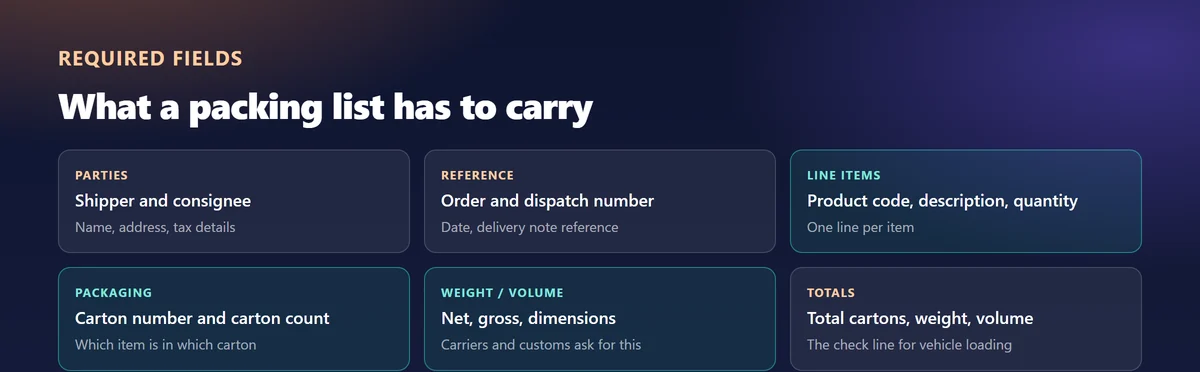
These are the document's fields; the label on the carton is a separate decision and does not carry the same list. We covered it separately: which fields go on the carton label itself
On export shipments the carton number and the net and gross weights on this list are also printed on the box itself, and the two have to match exactly. That side is covered separately: shipping marks on the carton.
On export lists these fields are usually headed with abbreviations: CTNS, PCS, N.W., G.W., MEAS, C/NO. Which abbreviation belongs to which document, and what to do when two documents disagree, is gathered separately: what the abbreviations on the list actually mean.
A packing list is not a delivery note or an invoice
This is the confusion we see most often. The three documents answer different questions and none of them replaces another. Putting amounts on a packing list, or carton numbers on an invoice, makes both less useful.

The next link in the chain - the document that records that the goods left - is covered in detail here: How to Write a Delivery Note
The other side reads the list too: when the count is wrong or a carton arrives damaged, what the receiving side does with that list is covered separately.
Note: obligations around delivery notes and invoices are set by local regulation; check your own situation with your accountant.
Preparing it step by step
The order matters: do not write the list before packing is finished. The biggest time loss we see comes from writing the list first and then trying to pack to match it.
- Finalise the orders and line items going into the shipment.
- Pack the items into cartons and give every carton a number.
- Record net and gross weight for each carton, plus dimensions if needed.
- Write the item-to-carton mapping into the list: how many of which product in which carton.
- Add the total carton, total net and gross weight lines, then sign the list.
Five common mistakes
- Not numbering cartons. Without numbers you cannot tell which carton a missing item was in.
- Mixing up net and gross weight. Freight is billed on gross.
- Not reflecting a last-minute change. If a carton is added, the totals line has to change too.
- Writing the list before packing.
- Keeping the list only in a folder. A copy should travel with the shipment.
If you prepare it in a spreadsheet
At low volume a spreadsheet is enough. But because the list is disconnected from the order data, you must update it by hand whenever the order changes — and that is the step most often skipped. We covered where spreadsheets break down in shipping in Why Spreadsheets Stop Working for Shipment Tracking.
If you are wondering about the step before packing — the document that says what to pick in the warehouse — see What Is a Picking List?.
If those carton numbers and weights also have to go on the outside of the cartons, there is a free carton label generator on this site: fill in consignee, order number, carton sequence, net and gross weight and measurements, then download a printable PDF - all 120 cartons in one file, numbered for you. No account, and nothing you type is sent to a server. Shipping mark generator.
What changes when the list is generated from the record?
Once the packing list stops being a separate table and becomes an output of the shipment record, the list changes when the order changes. In Smartifie Logistic the line items, carton numbers and package counts live on the same record; the list and the barcoded carton label are produced from the same data as the loading order. That removes the "the list says 12 cartons but 13 went on the truck" situation.
It runs on Windows, on Android (APK) and in a web browser; the interface is mobile-friendly, so you can use it from a phone on the warehouse floor.
Once the cartons on that list are stacked onto a pallet, a different question starts: who is liable when a pallet is damaged, and what has to be recorded before the truck moves.