
You are writing a supplier manual, or reading one. There is a page headed "shipping marks" and the factory wants to know exactly what to print on the outer carton. Every article you find hands you a different list of "mandatory information". Start somewhere else: most of those lists have nothing behind them. Very little of what goes on an export carton comes from regulation; the rest is decided by your sales contract, your letter of credit and the supplier manual you write yourself. Below we define the three blocks that sit on the box - main mark, side mark and handling marks - then count the marks that genuinely do come from regulation, each with its primary source, and finish with why those values should be pulled from a record instead of typed a second time.
Marks or labels? They are not the same thing
English at least has two words for it, but they still get used interchangeably. A label is a separate object: it carries a barcode, it talks to a machine, it mostly drives your own internal flow and the final delivery, and its job ends when the shipment does. A mark is printed, stencilled or inkjetted onto the carton itself; it talks to people, it is read by eye in the port and the warehouse, and it is what a customs officer compares against the paperwork. If one of them is torn off or soaked, the other is still there - which is exactly why both exist.
This article covers the mark side only. Which fields belong on the stuck-on label, what the barcode should carry and how that side is decided are covered separately: What to Put on a Carton Label.
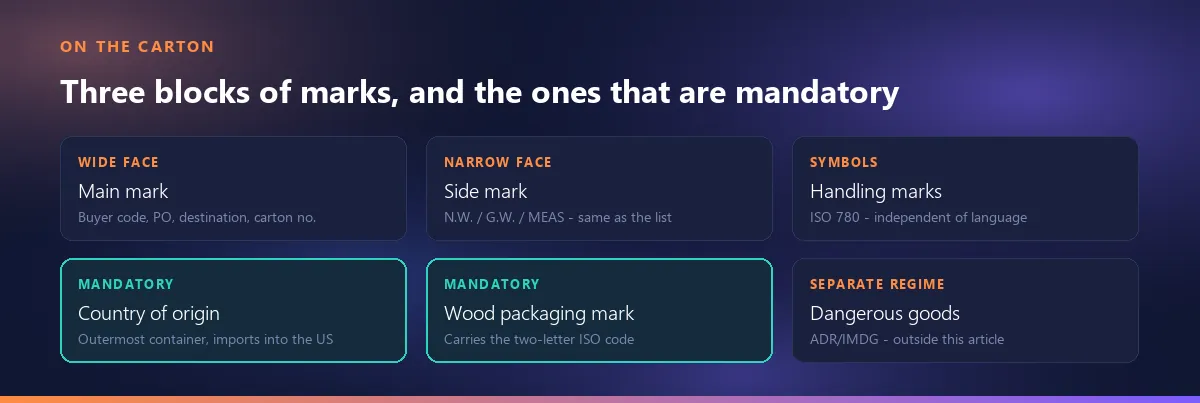
Main mark: what goes on the wide face
The main mark is the block printed on the widest face of the carton, and it identifies the shipment at a glance. Its purpose is narrow: when a container is being stripped, a person standing a few metres away has to see whose carton this is. What goes into it follows from that, and keeping it to about four lines is what makes it work.
- Consignee abbreviation or buyer code. Most supplier manuals ask for a three or four character code here rather than the full legal name. What that code is belongs to the buyer, not to you; if it is not asked for at order stage, it gets asked for later under pressure.
- Order reference. The buyer's own purchase order number. Not your internal order number - the receiving side can only find your carton in its own system through its own reference.
- Destination country and port or place of discharge. On transhipped cargo this single line is often the only thing keeping a carton out of the wrong stack.
- Carton sequence. Which carton this is, out of how many. Covered just below.
None of those four lines comes from a statute. They come from the buyer's supplier manual, from the sales contract or from the terms of the credit. There is therefore no such thing as a "standard main mark format"; it varies from buyer to buyer and it is meant to. Your job is not to invent it but to get it in writing at order stage.
The carton sequence lives here too
The carton sequence (the x/y form) is repeated in the main mark and usually in the side mark as well - the repetition is deliberate, because which face of the box is visible depends on how it was stacked. Why that field matters so much, and what its absence does at goods-in, is not repeated here; it belongs to a separate article: What to Put on a Carton Label.
Side mark: the narrow face (N.W. / G.W. / MEAS)
The side mark goes on the narrow face and carries weight and dimensions. The main mark answers "whose carton is this"; the side mark answers "how heavy is it and how much space does it take". It has a different audience: the forklift operator, the person building the stack, the forwarder measuring the consignment and the officer comparing the declaration.
Three abbreviations are close to universal in this block, and it is worth knowing exactly what they mean:
- N.W. - net weight: the goods only, without the packaging.
- G.W. - gross weight: goods plus packaging, which is what the scale reads.
- MEAS - measurement: the outer dimensions of the carton (length × width × height) and the volume derived from them.
There is one rule here and it is not about format, it is about consistency: these three values on the carton must be the same as the values on the packing list. Decimal separator, unit and rounding included. How those values are put together on the list itself is covered separately: How to Prepare a Packing List.
These three abbreviations live on the box; the documents for the same shipment bring others - CTNS, PCS, C/NO, P/O NO - and each belongs to a different document. We gathered that set separately: the other abbreviations you meet on the documents.
Do not go looking for a numeric "standard side mark format" - there is none. The abbreviations are settled; the order of the lines and the choice of units are left to the buyer's manual.
Handling marks: the symbols do have a standard
"Fragile", "this way up", "keep dry" are not drawings somebody invented. They have a standard: ISO 780, the standard for graphical symbols that convey handling and storage instructions on distribution packaging. The edition in force is ISO 780:2015, and its scope covers goods of all kinds - but it does not cover instructions specific to dangerous goods, which have their own marking regime (catalogue record for the standard).
The symbol beats text for one reason: it does not depend on language. The person handling your carton in the port does not have to read yours, only the symbol. Two practical warnings come with that. First, the standard itself is a paid publication, and the symbol images circulating online are not always identical to the current edition. Second, printing a symbol is not a guarantee of careful handling - it is evidence that the instruction was given. Rather than collecting symbols off the internet, verify which ones to print against the customer's supplier manual or against the standard itself.
Which marks are actually mandatory?
Everything so far came from a contract. Now for the part that comes from regulation - and notice how short the list is. The three examples below show that obligation on the outside of a box is not general but <strong>subject-specific</strong>: a mark arises either from the destination country's import regime, or from the packaging material, or from the goods themselves.
Country of origin marking - on imports into the United States
US customs regulation has an explicit rule about the container itself. Where the goods are excepted from marking, the outermost container in which the article reaches the ultimate purchaser shall be marked to indicate the country of origin of the article. And where containers are themselves subject to treatment as imported articles, they must indicate their own country of origin as well (19 CFR § 134.22).
Read that sentence together with the country. It is a rule about importing into the United States; it does not mean "every country requires origin on the outside of the box". Shipping somewhere else means checking that destination's own regime.
The wood packaging mark
The second obligation comes not from the goods but from the packaging. Where a shipment travels on wooden pallets, crates, cases or dunnage, the packaging must carry a mark issued by the relevant country's plant health authority bearing the two-letter ISO country code; the mark identifies the producer of the packaging and the treatment applied (GOV.UK guidance on wood packaging material). This is not something you print - it has to arrive already on the packaging you bought. The pre-loading check is simply that: is the mark on the pallet?
Everything about wooden packaging beyond the mark - stacking, securing, and who is liable when it arrives damaged - sits outside this article and is covered separately: who is liable when a pallet is damaged in transit.
Dangerous goods: a separate regime
If your goods fall under dangerous goods rules, the marking requirements do not come from anything described here. ADR for road and the IMDG Code for sea impose their own marking and labelling regimes, independent of the main mark / side mark logic. We draw the boundary and stop: if you are in scope, the right source is that body of rules for your mode of transport, not this article.
The section in one line: the genuinely mandatory marks are few and subject-specific; everything else is contract. This article is not legal advice - confirm the binding rule for your own product group and destination country with your customs broker or in the authority's own text.
Not naming the goods: neutral marking
A question that comes up constantly: should the box say what is inside it? For valuable and easily moved goods the common practice is that it should not. A carton that says "mobile phones" stands out in a stack waiting in a port; instead of the product name a code is used, and what the code means stays on the paperwork. This choice is called neutral or anonymous marking.
There is a point on the documentary credit side that gets mixed up constantly and is rarely stated plainly: when a credit calls for "anonymous packing" or "packing without marks", the requirement is aimed at the trade mark - it asks that the seller's brand not appear on the box. It does not prohibit the shipping mark itself. The opinion of the Spanish committee of the International Chamber of Commerce on this question (Consulta 57 - Embalaje anónimo o sin marcas) says exactly that: the function of the shipping mark is identifying the packages for the purpose of carriage and delivery, so carrying the applicant's or consignee's name does not conflict with the condition.
The practical outcome: neutral marking does not mean an empty box. The buyer code, the order reference, the destination and the carton sequence stay; what goes is the description of the product and the seller's brand. Even so, confirm the exact wording of the credit with your bank - these conditions are drafted differently from deal to deal.
What happens when the marks do not match the documents
The reference on the carton, the reference on the packing list and the reference on the bill of lading have to point at the same thing. The problem is almost never a completely different number; the problem is small differences. One document has a hyphen, the other does not. One uses a slash, the other a space. One keeps the leading zeros, the other drops them. A person reads those as the same reference; a record, and a check performed against a record, reads them as two.
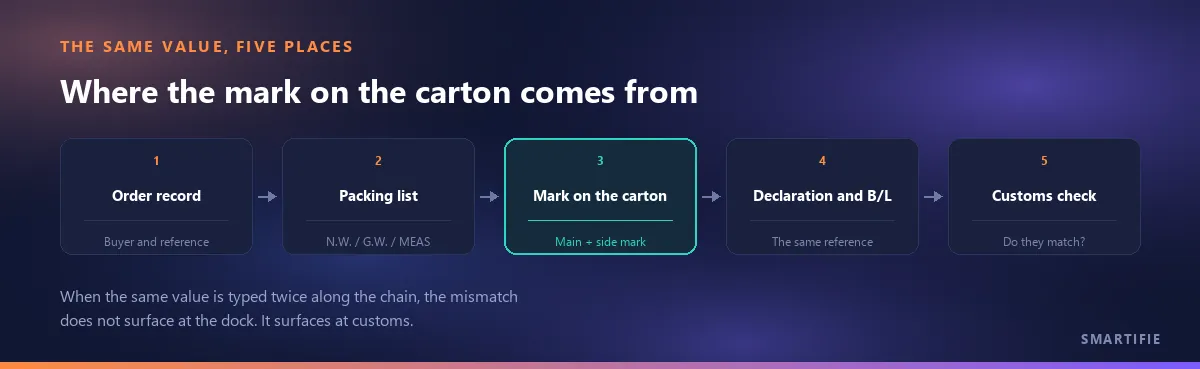
So the mechanism is not about format, it is about repetition. When the same weight is typed by hand in four places, keeping all four identical depends on a person. And when they drift, nobody notices at the dock - the carton has already left. The difference surfaces where documents are compared: at customs, or at the buyer's goods-in. The cost there is a cost in time. The document link of that chain is covered separately: How to Prepare a Packing List.
Where and how the mark is applied
There are three ways of doing it in practice, and the choice follows from volume, carton type and what the plant already owns. <strong>Stencilling</strong> is still the most durable method at low volume and on wooden crates; consumables are cheap, setup is slow. <strong>Inkjet printing</strong> runs inline and can change variable data such as the carton sequence automatically, but it is sensitive to the corrugated surface and to drying. <strong>Large-format printing</strong> produces the mark block as a separate surface and applies it to the carton; it gives the most legible result and costs the most.
Two practical criteria survive whichever method you use. First, permanence: the mark has to stay readable through moisture, abrasion and handling - which is why pencil, ballpoint and water-soluble ink are not used for marks. Second, visibility: which faces of the carton are exposed depends on how the load is stacked, so there is no single correct answer to "how many faces should carry the mark". The right approach is to look at your own packing and stacking pattern and pick the faces that end up facing outward. If the buyer's supplier manual sets a rule here, that rule comes before yours.
What changes when the marks come from the record
Let us set the boundary first, because this article has nothing to sell: Smartifie Logistic does not produce a main mark or side mark block. There is no free-text mark field, no stencil output, no direct-to-carton printing, no ISO 780 symbol printing, no wood packaging mark and no country of origin mark. The "Country of Origin" field that exists in the app is a field on the customer record - it is not the origin of the goods and cannot be used as an origin mark. None of the marking work described in this article is done in the app.
What the app does not do, a free tool on this same site does: you assemble a main mark / side mark block in your browser - consignee, order number, carton sequence (7/120), net and gross weight, measurements, an origin line and ISO 780 handling symbols - and download it as a printable PDF, with all 120 cartons in one file and the sequence numbered for you. The tool is not part of the app, asks for no account, and nothing you type reaches a server - it is generated entirely in your browser. One thing stays where it was: the tool prints what you type, and which marks genuinely bind you - the origin mark included - is still yours to verify from the sections above. Shipping mark generator.
What we do have is the step before, and it lines up with what this article is actually about: the three values that go into a side mark are already in the record. Net weight, gross weight and volume are fields on the packing list record; the pack number, the total number of packages, the HS code and the customer's own order code sit in the same place. The values you are about to write on a carton are therefore not data to be produced a second time - they are data that already exist somewhere. The packing list is exported from that same record, and a label is printed from the order record, with each label row configurable to show a chosen field.
Weight and volume are not among the row options on that label - the data sits in the packing list, not on the label. How label printing works is described on a separate page: How to print shipping labels.
The closing line returns to where the article started: most of what goes on a carton comes from the contract rather than from the law, so instead of hunting for a mandatory list there are two things to do. First, verify the small number of marks that genuinely bind you, for your own product and your own destination. Second, take the contractual values from the record where they already sit instead of typing them a second time.