
You already know what a bin location is, and you have probably already built the code for one. The question that follows is the one nobody answers: once the bins exist, what decides which item goes into which bin? Either every SKU owns a bin and keeps it whether it is full or empty, or goods go into the nearest free space and the system remembers where. Search for it and you get vendor blogs explaining how to set bins up in the first place. This article is about the rule you apply afterwards — and about which of the two rules your warehouse can actually sustain.
The argument in one line: this is not an efficiency debate, it is a debate about a promise to record. A warehouse that puts goods into whatever space is free only works if every put-away is captured at the moment it happens. For a team that cannot make that promise, fixed bins are a slower warehouse that is nevertheless findable. There is a second line, and on the floor it is the decisive one: the decision is made at receiving and at the returns shelf, not at picking. Nobody forgets to record a pick; everybody forgets to record a put-away.
The difference in one line: does the bin belong to the item or to the record?
Both systems change exactly one thing: who owns the bin. Under fixed locations the bin belongs to the item. The item lives there, and when it runs out the bin waits empty rather than taking something else; nobody fills it “for now”. Under random (chaotic) storage the bin belongs to the record: goods go wherever there is space, the placement is written down, and the person who knows where the goods are is not the person who put them there but the person reading the record.
That distinction is not our invention; it sits in the definitions themselves. Mecalux's page on location criteria describes fixed slotting as assigning each SKU a concrete position in advance, which makes goods findable “sin necesidad de tener un sistema informático que lo registre” — without needing a computer system to record it. The same page says the opposite about chaotic storage: items are placed into whatever bins are free as they arrive, and in that arrangement “resulta indispensable usar un sistema de gestión de almacenes” — using a warehouse management system is indispensable (Mecalux, criterios de ubicación).
A word on names before we go on, because the rest of the article uses two: fixed bin locations and random or chaotic storage. The two terms for the second one mean the same thing and nothing in this article depends on which you prefer. One more boundary: this piece is not about how to name the bin. How many segments the code has, how wide each one is and which characters you refuse to use are a separate subject, covered separately: the location code itself. The distinction built there — an address identifies the place, not the goods — is assumed here.
The paper test: if the system stops, can you still find the goods?
The genuine advantage of fixed bins is not efficiency. It is this: fixed locations do not require a system to tell you where anything is. Because an item always sits in the same place, anyone who knows the warehouse walks to it, and a new starter reads it off a printed list on the wall. When the power goes, the network drops, a battery dies or an update goes sideways, the warehouse keeps working.
Random storage has no such fallback. In Christoph Roser's treatment of the strategy, the heaviest entry on the minus side is exactly that: because the operator takes the nearest open bin, the location of the goods lives only in the record, so if the system stops, the operation stops (AllAboutLean, random/chaotic storage). Read that as a precondition rather than a risk: it is the first filter of the decision and it outranks every other question below.
The test is simple and you can run it this week: switch the system off, hand out paper, and have a ten-line order picked. If the team can do it, that is precisely what fixed locations buy you. If they cannot, that is not a failing but a piece of information — before moving to random storage you need to know how reliable that system is, whether it has a fallback, and what the floor does during an outage.
What fixed bins cost: space that sits empty on purpose
What fixed bins cost is space, and the reason is arithmetic. The number of bins reserved for an item is set by its maximum stock, not its average — because the goods have to fit in their own bin on the fullest day too. Roser states the rule plainly: under fixed locations you must not put any other item into those spaces, and each item needs enough slots to cover its peak requirement.
The same author works through a calculation example that is enough to show the order of magnitude — it is his own illustration, not an industry statistic: with 1,000 distinct items, an average of 10 units each and a 95% service assumption, fixed locations need roughly 18,000 slots while random storage gets by with roughly 10,260 (AllAboutLean, fixed location storage). Your own numbers will differ; the direction will not — fixed always asks for more slots.
The real cost is not the space: it is the new item with no home
On the floor, fixed slotting does not collapse because the racking filled up. It collapses at the door, over the new item nobody assigned a home to. When a new SKU arrives it has no bin, because every bin already has an owner. So it goes “for now” into an aisle, onto the top of a pallet, beside the office or under the receiving bench. That is not a bin: nobody asks about it and nobody counts it. The goods are in the building and invisible to the system.
So the sustainability of fixed slotting comes down to one habit: when a new item arrives, open a bin for it <em>that day</em> and write the bin onto the list. A team that does this carries fixed locations for years. A team that does not has fixed locations on paper only — the warehouse has already drifted into random storage, just without the record that makes random storage work.
What random storage costs: the moment of recording
Putting goods into any free bin is not free either; what it costs is not space but a moment. Random storage stands up only if every put-away is recorded as it happens. Record it an hour later, batch it at the end of the shift, or write it down when you remember, and the record becomes wrong — and it is worth being blunt here: a wrong record is worse than no record. Goods with no record get searched for and found; goods with a wrong record are never searched for, because the system believes it already knows.
The best-known example of that condition is Amazon, and the lesson here is not “Amazon does it, so should you” — it is the opposite. Amazon's own page says inventory in its fulfilment centres is “stowed randomly” and that entirely unrelated products may share a bin; but the same sentence sets the condition: all of them “tracked by computers” (Amazon). What is random is the placement; the record is not random. What holds the warehouse up is not the freedom of the put-away but the fact that the record has no exceptions.
Wherever the record lags behind reality, the system is wrong, and that rule is not specific to warehouses: the same failure shows up when shipments are tracked in a spreadsheet.
Discipline breaks at receiving and returns, not at picking
The most common mistake on the floor is to look for recording discipline at picking. Picking defends itself: the picker takes the goods, the order closes, a document comes out — an unrecorded pick gets noticed on its own. Put-away does not work like that. Nobody is waiting for a put-away record and nobody asks at the end of the day how many items went onto the racking. That is why discipline breaks in three places, and all three are next to the door.
- Haste at receiving. The truck is waiting, the dock is full, the unloaded goods need to get out of the way. The goods go onto the racking, the record becomes “I'll enter it later”, and later frequently never arrives.
- Returns and goods that come back from picking. This is the category that disappears most often, because no document is attached to it. Goods returned by a customer, or carried back because an order was cancelled, land on a “returns shelf” — which in most warehouses is a habit rather than a bin, has no record, and quietly accumulates stock for months.
- The end-of-shift catch-up. Records missed during the day get entered in one go in the evening. It is a well-meant habit and that is exactly what makes it dangerous: an entry made in the evening was already too late for whoever looked for those goods during the day, and because it is written from memory it is more likely to be wrong.
The decision is made at those three moments. A warehouse that wants to move to random storage should look there first; assuming the system will hold because picking looks tidy is deciding from the easiest corner of the building.
The third option: the hybrid most small warehouses should be running
You are not obliged to pick one. Mecalux's page says as much: in many installations “se aplican criterios de ubicación mixtos” — mixed location criteria that combine both approaches. The general rule the same source gives is simple and forms the backbone of any hybrid: fast-moving goods sit close to the inbound and outbound doors, and the slower the turnover the further out an item goes.
The practical hybrid is this: a small number of fast movers get fixed bins near the door, and everything else goes wherever there is space. You then pay the cost of fixed slotting only on a small slice of your stock while keeping the flexibility of random storage across the rest. The common framework for deciding which items count as fast is ABC classification: items are grouped by turnover and the group sets how far from the door they live. How that classification is calculated is not this article's subject; what matters here is that a hybrid is not “half fixed, half random” — the rule about which item falls under which regime has to be written down.
The other half of a hybrid shows up on the picking side: the document that tells the floor what to take and in what order is where your slotting decision gets tested: the picking list.
Four questions settle it
This is the spine of the article. Four questions, each a one-line yes or no; the answers make the decision for you.
- Does the person putting goods away have a recording device in their hand at that moment? A phone, a handheld terminal, a screen fixed at the dock — anything that lets the record happen at the same moment as the placement.
- Is your range growing, or has it been the same for years? The difference between a handful of new items a year and dozens a month decides how long fixed slotting survives.
- Does one item arrive in quantities that fill several bins at once? If a single delivery fills half an aisle, the layout drifts towards a hybrid whether you planned one or not.
- How often do you count, and on how many items did the last count fail to match? This question measures the team, not the system.
How to read it: if the answer to 1 is no, the discussion is over — fixed bins. Where the record cannot be made, random storage is not a preference, it is a loss. Yes to 1 and yes to 2 means random or hybrid will work for you. Yes to 3 points at a hybrid: that item is already occupying several bins. If 4 came back with a wide gap, the next step is counting discipline, not a change of system — a warehouse whose counts do not match will not be fixed by changing the put-away rule.

Where the goods decide for you
For some goods the choice of bin is not free. That is not a preference but a constraint that comes from the goods themselves, and it belongs on the fixed side of a hybrid — though as a predetermined area rather than a single assigned bin.
- Temperature-controlled goods: the chiller or the climate-controlled section is already an area; the goods go in there and cannot live outside it.
- Dated or batch-controlled goods: the real constraint is not the space but the order of issue — first to expire, first out (FEFO). That order requires batches of the same item with different dates to sit apart rather than mixed together.
- Goods that must be kept apart: where one item taints, stains, leaks onto or otherwise spoils another, adjacency is a rule rather than a preference.
- Heavy and bulky goods: weight forces the lower levels and volume forces the wide bins. Between them, the set of eligible bins narrows to a short list and the “free” choice stops being free.
- Goods reserved for a customer: stock allocated to an order is not really allocated until it is physically separated. The reserved area is an area, and nothing else goes into it.
Every line on that list already forces a hybrid. For most warehouses, then, the question is not “fixed or random” but “how much of the building can I leave free”.
The switch: start with one aisle, close it with a count
Moving from fixed to random storage is not a weekend job, and converting the whole building at once is the most expensive route. The right way is narrow and reversible: one aisle, one week, one measurable output.
- Pick one aisle — preferably one holding slow movers, so that a mistake there costs the least.
- Empty those bins and record them by counting. The starting point of the switch has to be a counted quantity rather than an estimate; otherwise any discrepancy a week later cannot be attributed to the switch or to an error that predates it.
- Run one week of free put-away in that aisle only and measure a single thing: the number of unrecorded put-aways. What you are measuring is not speed, it is discipline.
- If it did not hold, roll back. Rolling back is cheap because your location codes did not change; the bins are the same bins and the only thing that changed was the rule about what goes into them.
- If the week came back clean, take the second aisle and repeat the same measurement. The whole warehouse converts aisle by aisle, with a measurement at every step.
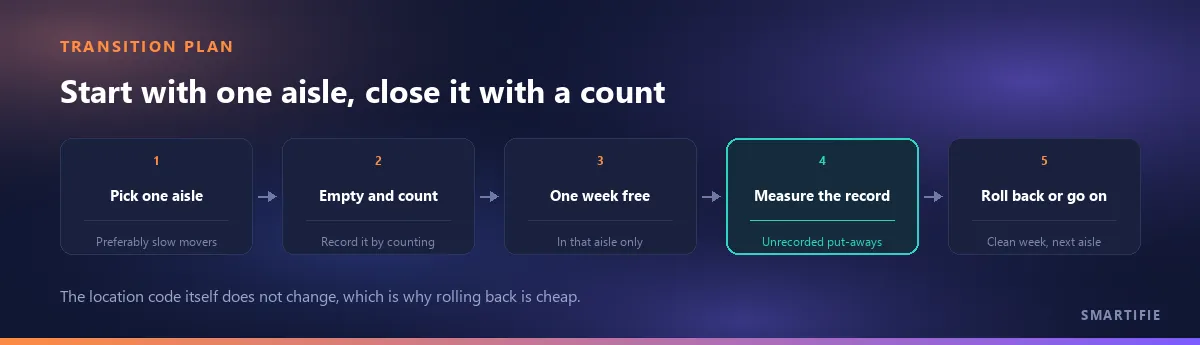
The location code itself does not change during this switch. If you do not have one yet, or the one you have will not carry the job, that is the thing to build first: how to build the location code itself.
During the switch you do not keep two records
Keeping the old book and the new system in parallel for a week feels like the safe option. What happens on the floor is different: both end up half kept. People do not write in two places at once; the second record always falls behind the first, and by the end of the week nobody can say which one is right. Worse, a discrepancy teaches you nothing, because you cannot tell whether it came from the switch or from the double bookkeeping.
The rule is one sentence: <em>one record, narrow scope.</em> Limiting the scope to a single aisle is what makes it safe; a second book adds noise, not safety.
Three signs on the floor that you chose wrong
(a) The picker says it is not there, the record says it is, and the goods turn up in a different bin the next day. That is the clearest sign that the moment of recording has broken: something was put somewhere and not captured at the time. It means you are not carrying random storage; either you move the device to the moment of put-away, or you go back to fixed bins.
(b) The same item has piled up in three separate bins and nobody knows which to draw from. One item in several bins is normal under random storage; what is abnormal is having no rule about which bin gets picked first. That is a hybrid being run without a written rule, and the result is not slow picking but bins that never empty.
(c) Somebody says there is no room for a new item while the racking is half empty. That is exactly the picture fixed slotting produces: the bins are not full, they are reserved. The warehouse is telling you it is out of space when what it is out of is rule — and it is the clearest invitation to move to a hybrid.
To close, in one line: the decision itself is reversible — the only thing that is not is an unrecorded put-away. Move from fixed to random and dislike it, and you move back; but there is no button that recovers goods placed on a shelf without a record. Only a count finds those.
What we do on this side, and what we do not
We have no module to sell here, so plainly: Smartifie Logistic has no location or bin management. There is no bin code field, no put-away suggestion, no bin occupancy, no bin-to-bin transfer, no counting by location. You cannot implement the decision described in this article through our app; you implement it in your ERP or your warehouse management system.
What we do is narrower: we hold the product measurements this decision needs on a single record. The item card carries width, length and height with a dimension unit, net and gross weight with a weight unit, a calculated volume (CBM) and the pack size; the shipping documents read them from there. When you build a hybrid, those are the fields that decide which level and which bin width an item can go into — the decision is yours, the input can live with us.
Why those fields sit empty in most warehouses, and what it costs later, is covered separately: the dimension fields on the stock card.