
A hotel group in Toronto likes your price and wants the terms in writing before it orders. You add two lines to the quote: “30% down payment, 70% balance on delivery” and “Delivery: 45 days.” Both look fine. But if you mean the day the truck leaves your dock in Chicago and the customer means the day the goods reach the hotel, the same quote promises two different payment dates, and nobody notices when it's signed.
The short answer: every row of a payment plan is tied to an event, and the delivery term on the quote is where that event happens. An Incoterm doesn't say when you get paid, and a payment plan doesn't say where delivery takes place. Unless you tie the two to the same point, “balance on delivery” means two different days, and often cash in two different months.
“Balance on delivery”: which delivery?
At a sales desk, “delivery” has two natural meanings. For the seller it's the moment the goods leave their hands: loaded, paperwork done, the truck out of the gate. For the buyer it's the moment the goods arrive: the truck pulls in, the goods are counted, they go into the hotel's storeroom. The road, the border and the unloading in between take days, sometimes weeks. If the quote doesn't say which of the two it means, each side assumes its own.
Where it starts to matter is the balance due date. If the goods leave Chicago on November 28 and reach Toronto on December 3, “30 days from delivery” is December 28 in your books and January 2 in the customer's. The same balance lands in two different months of cash forecast, and when the day comes, both sides believe they're right. This is settled while the quote is being written, not at collection time: then, it takes one sentence; later, it takes a thread of emails.
An Incoterm doesn't cover payment; a payment plan doesn't name the place
On an export quote the Incoterm is often assumed to close this gap: “I wrote DAP Toronto, so the place is settled.” The place is settled; the payment isn't. The International Trade Administration of the U.S. Department of Commerce puts it plainly: Incoterms rules don't reference the method or timing of payment, and they don't say when title to the goods passes (trade.gov, Know Your Incoterms). Each rule, on the other hand, is written against a named place: a place of delivery, a port of loading or a port of destination.
So the quote carries two lines that answer two different questions. The delivery term answers where; the payment plan answers when and how. Since neither answers the other's question, they have to refer to each other: the “delivery” in the payment row has to point at the place in the delivery-term row. This article won't teach you the Incoterms rules; who carries which cost and risk from where to where is in the ICC's own publication. The only fact we use here is where delivery takes place under each rule. For what abbreviations like EXW, FOB and CIF stand for, see the abbreviations on export paperwork.
The fifth part of a payment row: the event
A payment row is usually written with four parts: the stage (down payment, interim payment, balance), the method (bank transfer, letter of credit, cheque…), the share (30%) and the due days (30 days). Even with all four filled in correctly the row is incomplete, because “30 days” points at no date until it has a starting point. The fifth part is what the days are counted from.
On the seller's side, the usual events to pick from are: the order being confirmed, production finishing and the goods being notified as ready, loading, the invoice being issued, delivery (at the place named in your delivery term), and the goods reaching the buyer. Each is a different date, and as the example above shows, the gap between them can move the payment into another month. Choosing the event is a commercial decision; writing it down is one sentence.
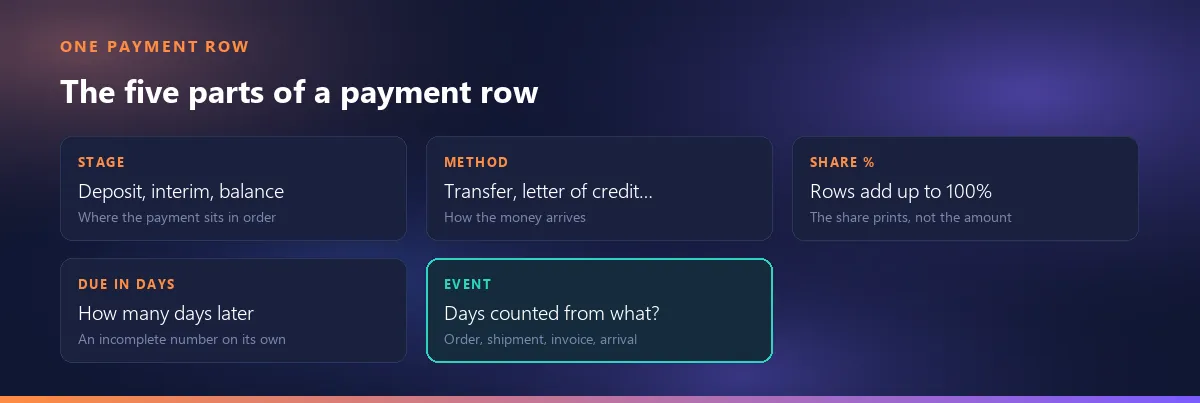
In Smartifie Quote the payment plan keeps the stage, method, share and due days in separate columns; it does not have a separate field for the event. We suggest writing the event as one sentence in the delivery note, which is printed next to the delivery time on the document. For example:
“Delivery: 45 days from receipt of the down payment. Balance due within 30 days of delivery at Toronto.”
Two events, two sentences: the delivery time counts from the down payment, the balance counts from delivery, and delivery happens in the city named in the delivery term. If you leave a payment row's due days at 0, no day count is printed; the row just states the stage and the method. Even then, it's the sentence in the note that says which delivery “on delivery” means.
What the down payment waits for, and what the balance waits for
The down payment's job is to cover what you'll spend before delivery: materials, a production slot, a part made just for this customer. The balance is about the goods leaving your hands, and there are three basic options: before loading (the goods don't move until the balance arrives), against documents (against the shipping document, or paperwork routed through the banks) and after delivery or arrival (the goods reach the buyer and the money comes on its due date). Each step down that list means a little more risk for the seller.
The same logic shows up in the general ranking of export payment methods. The International Trade Administration lists five basic methods in order of risk to the exporter: cash in advance, letters of credit, documentary collections, open account and consignment (trade.gov, Methods of Payment). What a letter of credit asks of your quote and proforma is covered in what to include in an export proforma invoice.
We're not recommending a split. The 30% down payment and 70% balance in the video are only an example; the right split depends on your cost structure, your history with the customer and your negotiating position. All this article says is that whatever the split, the quote has to state <strong>which event</strong> the balance waits for.
Matching the balance to the point of delivery
You don't need to know the rules to see which balance sentence fits which Incoterm; you only need to look at where delivery takes place. On that axis there are three situations.
- Delivery at your end (EXW, FCA, FOB and the like). Delivery happens in the country of shipment, often at your warehouse or the port of loading. “Balance before loading” or “balance against the shipping document” points at the same place as the delivery. “Balance 30 days after arrival” waits for a different event that comes after delivery; you can write that too, but then don't call it “on delivery”.
- C rules (CPT, CIP; by sea, CFR, CIF). The city written next to the code is the destination, but delivery happens at the shipping end; as the ICC Academy puts it, under these rules risk doesn't pass at destination (ICC Academy, C or D rules). A seller who writes “CPT Toronto” on the document and “balance on delivery” in the payment plan can mean two different places without noticing: the code points to shipment, the city name suggests arrival. This is where naming the event outright (loading or arrival) helps most.
- Delivery in the customer's city (DAP, DPU, DDP). Delivery happens at the named place of destination. Here “balance on delivery” means the customer's city, and that's where the due days start. That's the example in the video: DAP Toronto, a 70% balance, due 30 days from delivery.
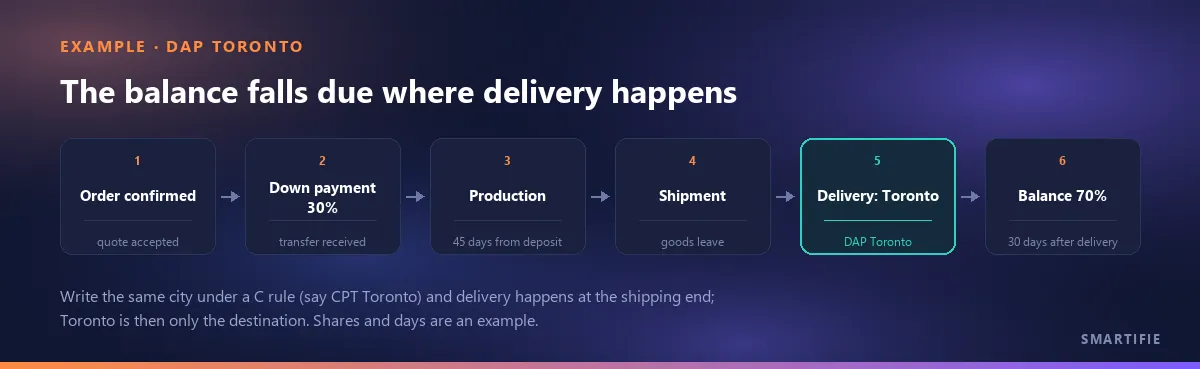
In the video we build the same quote for the Toronto hotel group from scratch: a two-row payment plan (30% down payment, 70% balance, 30 days), a 45-day delivery time with the note “from receipt of the down payment”, Export as the type of sale, and Incoterms DAP with Toronto, ON as the place of delivery:
Watch how it works
Real screens, start to finish.

Quote Payment Terms: Deposit, Balance and Incoterms | Smartifie Quote
How to set quote payment terms in Smartifie Quote: a down payment and balance plan, a delivery time, the type of sale and an Incoterm with its place of delivery.
The video loads from YouTube when you press play.
If you'd like to try the steps on your own quotes: a quoting tool that keeps the payment plan and the delivery terms on one document.
Delivery time: days, an event, and “to be advised”
Delivery time is also counted from an event, and on the seller's side that event is usually receipt of the down payment: production doesn't start until the money is in. So “45 days” on its own is as incomplete as the “30 days” in the payment row. If the down payment arrives a week late, delivery slips by a week; unless the quote says so up front, the document makes the delay look like yours. “45 days from receipt of the down payment” puts that slip on the record in advance.
If the production slot isn't fixed yet, leaving the delivery time blank is a legitimate choice. In Smartifie Quote a blank delivery time isn't printed as a gap but as a phrase: “To be advised” on an English document, “Bilahare bildirilecektir” on a Turkish one, “Se comunicará más adelante” on a Spanish one. Any delivery note you write is printed next to it.
Don't confuse the delivery time with the quote's validity period: one says when the goods will be delivered, the other how long the price stands. We covered what a quote's validity period protects in a separate article.
What language the customer reads: codes are translated, the Incoterm isn't, your note isn't
On a quote going abroad these lines behave in three different ways. Values picked from a list (stage, method, a listed type of sale) print in the document's language: the same row reads Down payment and Bank transfer on an English document, and Anticipo and Transferencia on a Spanish one. The Incoterm code is the same three letters in every language; DAP is DAP on every document. Text you type yourself, meaning the delivery note and a type of sale that isn't on the list, is printed exactly as written and isn't translated. So write the sentence that names the event in the language the customer will read.
How the Incoterms field works in Smartifie Quote (it's off by default and prints as a single line once you turn it on) and the rest of the fields on an export proforma are covered in what to include in an export proforma invoice.
What the tool does here, and what it doesn't
In Smartifie Quote the payment plan is made of rows, and a plan that doesn't total 100% can't be saved; the screen says “The payment plan must total 100%.” A new row opened with “Add payment row” takes the remaining percentage by itself: after a 30% down payment, the new row comes in as a 70% final settlement. Each row's amount is worked out from the grand total and shown in the editor; what prints on the document is not the amount but the share, stage, method and due days. For which row absorbs the leftover cent in a payment plan, see the separate article. The terms block prints between the customer details and the items, so the customer reads the conditions before reaching the prices.
To be clear about what it doesn't do: Smartifie Quote doesn't track due dates, follow up on collections, send payment reminders or issue invoices. A quote or a proforma isn't an accounting document; the due days are a condition printed on it, not a date anyone tracks. Choosing the Incoterm is your decision and your buyer's; the product doesn't suggest a rule, and the picker only shows a short description of each code. And finally, a quote doesn't replace a contract. When the payment and delivery clause moves into a sales contract, have your lawyer read it.
To close, in one line: write down which event each payment row counts from, and tie the place of that event to the same point as the delivery term. For the fields to add when the same quote becomes an export proforma, see what to include in an export proforma invoice.
A quoting tool that keeps the payment plan and the delivery terms on one document